


Most custom software projects land between $15,000 for a simple MVP and $1.5 million or more for an enterprise platform, with the average project costing around $132,480 and taking roughly 13 months to deliver. That range is wide enough to be almost useless on its own, which is exactly why your next move matters more than the number itself: get a scoped discovery conversation before you accept or reject any vendor quote.
A discovery session, whether it takes half a day or two weeks, forces the vague idea in your head into a written scope a developer can actually price. Before that call, prepare three things: a list of core workflows the software must support, any systems it needs to talk to, and a rough sense of your budget ceiling. Vendors who ask for this upfront are usually the ones who quote accurately the first time.
Three variables decide which end of the cost band you land on:
- Feature count and complexity — a five-screen internal tool costs a fraction of a multi-role platform with dashboards and permissions.
- Integrations required — connecting to Salesforce, an EHR, or a legacy ERP adds engineering hours that rarely show up in a first estimate.
- Compliance and security needs — HIPAA, SOC 2, or financial-services requirements change both the build and the ongoing maintenance cost.
Statistic Callout: Clutch’s 2026 pricing research puts the average monthly software project spend near $10,209, which over a typical 13-month timeline is where that six-figure average comes from. GetProjects.ai reports a very different reality for smaller buyers: median budgets for startups and SMEs often sit between $8,000 and $25,000. Both numbers are correct. They’re just describing different buyers.
Key Takeaways
Custom software typically costs $15,000 to $150,000 for small to mid-size builds and $400,000 or more for enterprise systems, and accurate pricing depends on scoping before quoting.
| Point | Details |
|---|---|
| Know your bucket | Match your project to a size band (MVP, small app, mid-size, enterprise) before requesting quotes. |
| Budget for maintenance | Set aside 15 to 20 percent of the build cost annually for ongoing support and updates. |
| Scope before you quote | Poor scope definition can inflate final cost by 40 to 80 percent, so invest in discovery first. |
| Compare inclusions, not just price | A lower bid with vague deliverables usually costs more once change orders start. |
| Start with a scoped conversation | Seattlesoftwaredevelopers offers a discovery-led estimate process built for enterprise-ready, security-conscious builds. |
Table of Contents
- How Much Does Custom Software Cost by Project Size?
- What Factors Actually Drive Custom Software Development Cost?
- Fixed Price, Time and Materials, or Dedicated Team: Which Pricing Model Fits?
- How Long Does a Custom Software Project Take?
- Who Should Build Your Software: In-House, Agency, or Freelancer?
- How Do You Get an Accurate Custom Software Estimate?
- What Do Industry Benchmarks Say About Custom Software Cost?
- What I’ve Learned From Reviewing Hundreds of Software Quotes
- Get a Scoped Estimate for Your Custom Software Project
- Sources
How Much Does Custom Software Cost by Project Size?
Custom software pricing splits cleanly into a handful of buckets once you know what each one actually buys you. Trying to compare an MVP quote to an enterprise quote is like comparing a food truck to a restaurant build-out. Both feed people, but the scope, staffing, and risk are not remotely alike.
- Simple MVP or single-purpose app ($15,000–$50,000): A focused build with one or two core workflows, minimal integrations, and a small team. LinkTech Solutions places this band at $15K–$50K, and Codestringers’ figures for small focused builds run somewhat higher, $40,000–$150,000, depending on how “simple” the client’s definition really is. Timeline: 2 to 4 months.
- Small business web or mobile app ($50,000–$150,000): Multiple user roles, a proper database architecture, one or two third-party integrations, and a design pass that goes beyond templates. Timeline: 4 to 7 months.
- Mid-size application ($150,000–$400,000): This is where most B2B platforms live. Think multi-tenant SaaS, internal operations tools with several integrations, or a patient-facing portal with compliance requirements baked in. Codestringers’ mid-size band matches this closely. Timeline: 6 to 12 months.
- Enterprise system ($400,000–$1.5M or more): Complex permissioning, legacy system integration, high-availability infrastructure, and often a phased rollout across departments or regions. Timeline: 12 to 24 months.
- AI-native or highly regulated platform ($200,000 and up, highly variable): Custom machine learning pipelines, model training and retraining costs, and compliance overhead push these projects into unpredictable territory even when the visible feature list looks modest.
| Project Type | Typical Cost Range | Core Deliverables | Rough Timeline |
|---|---|---|---|
| Simple MVP | $15,000–$50,000 | One core workflow, basic UI, single database | 2–4 months |
| Small business app | $50,000–$150,000 | Multiple roles, 1–2 integrations, custom design | 4–7 months |
| Mid-size application | $150,000–$400,000 | Multi-tenant architecture, several integrations, compliance basics | 6–12 months |
| Enterprise system | $400,000–$1,500,000 | Legacy integration, high availability, phased rollout | 12–24 months |
| AI-native/regulated | $200,000+ (variable) | ML pipeline, model retraining, audit trails | 6–12 months |
Here’s a concrete example. Say you’re building an MVP for a scheduling tool with one integration into a payment processor. Expect roughly $35,000 to $45,000: 300 to 400 hours of engineering at a blended rate, plus design, project management, and QA layered on top. Add a second integration or a compliance requirement and that number can jump 20 to 30 percent before a single new feature gets added.
What Factors Actually Drive Custom Software Development Cost?
Every quote you receive is really a bet on how much uncertainty the vendor thinks your project carries. The factors below are the ones that move that bet the most.
- Feature scope and count. Every screen, workflow, and edge case adds development and QA hours. A “simple” app with 40 discrete features is not simple.
- Integrations. Each third-party system you connect to (a CRM, a payment gateway, an EHR) brings its own documentation quality, rate limits, and failure modes that eat engineering time.
- Data migration. Moving records out of a legacy system is rarely a copy-paste job. Wikipedia’s overview of data migration captures why: it involves mapping, cleansing, and reconciliation work that often rivals building a new feature from scratch.
- UI/UX design polish. A wireframe-level interface and a fully designed, tested user experience can differ by tens of thousands of dollars, especially for consumer-facing products.
- Compliance and security requirements. HIPAA, SOC 2, PCI DSS, or GDPR obligations add architecture review, audit logging, and penetration testing that a standard internal tool never needs.
- Performance and scale requirements. Software that needs to handle real production traffic at volume requires load testing and infrastructure planning most quotes underestimate.
- Third-party licensing. Mapping APIs, enterprise SDKs, or specialized data feeds sometimes carry per-seat or per-call fees that stack up over a project’s life.
- AI or specialized algorithms. Custom machine learning work adds data preparation, model training, and ongoing retraining costs that a static feature never incurs.
- Team composition and location. A senior-heavy, US-based team costs more per hour but often finishes faster and with fewer rework cycles than a junior, distributed team.
One of the clearest patterns in the industry is also the least discussed: poor scope definition alone can inflate final project cost by 40 to 80 percent compared to the original estimate. That’s not scope creep from a demanding client. It’s the natural result of a vendor pricing against an incomplete brief and discovering the real requirements mid-build.
Pro Tip: Before you request quotes, write a one-page “won’t do” list, features and integrations you’re explicitly deferring to a later phase. Vendors price uncertainty conservatively. Removing ambiguity about what’s out of scope often shaves more off a bid than negotiating the rate.
A single compliance requirement discovered late in a project can significantly multiply costs. For instance, a healthcare scheduling tool initially quoted in the lower eight-figure range can increase substantially when HIPAA-related features like audit logging, encrypted storage, and access controls are added retroactively, as retrofitting security is more expensive than designing it upfront.

Fixed Price, Time and Materials, or Dedicated Team: Which Pricing Model Fits?
Vendors price custom software work in one of three ways, and all shifts risk between you and the developer differently.
- Fixed price works best when scope is well defined and unlikely to change, such as a clearly specced MVP. The vendor absorbs the risk of scope creep, which is why fixed bids often carry a built-in buffer of 15 to 25 percent.
- Time and materials (T&M) fits projects where requirements will evolve, which is most mid-size and enterprise builds. You pay for actual hours worked, and the vendor bills at an hourly or blended rate.
- Dedicated team or retainer makes sense for ongoing product development or staff augmentation, where you need consistent capacity over months or years rather than a single deliverable.
Hourly rates vary sharply by region and seniority, and understanding the difference between a “nominal” rate and a blended rate matters when comparing bids.
Clutch’s data indicates many projects fall within the $25 to $49 per hour bracket for some technologies, reflecting a mix of offshore and nearshore firms rather than an overall market standard rate. A blended rate averages the cost of a project’s mixed team, say, a senior architect at $150 an hour alongside two mid-level developers at $80, into a single number you can multiply against total estimated hours.
Here’s a simple example calculation. If a vendor quotes a blended rate of $95 per hour and estimates 900 hours for a mid-size application, your budget comes to $85,500, before adding project management overhead, which typically runs another 10 to 15 percent on top. That puts the realistic total closer to $94,000 to $98,000, comfortably inside the mid-size band covered earlier.
How Long Does a Custom Software Project Take?
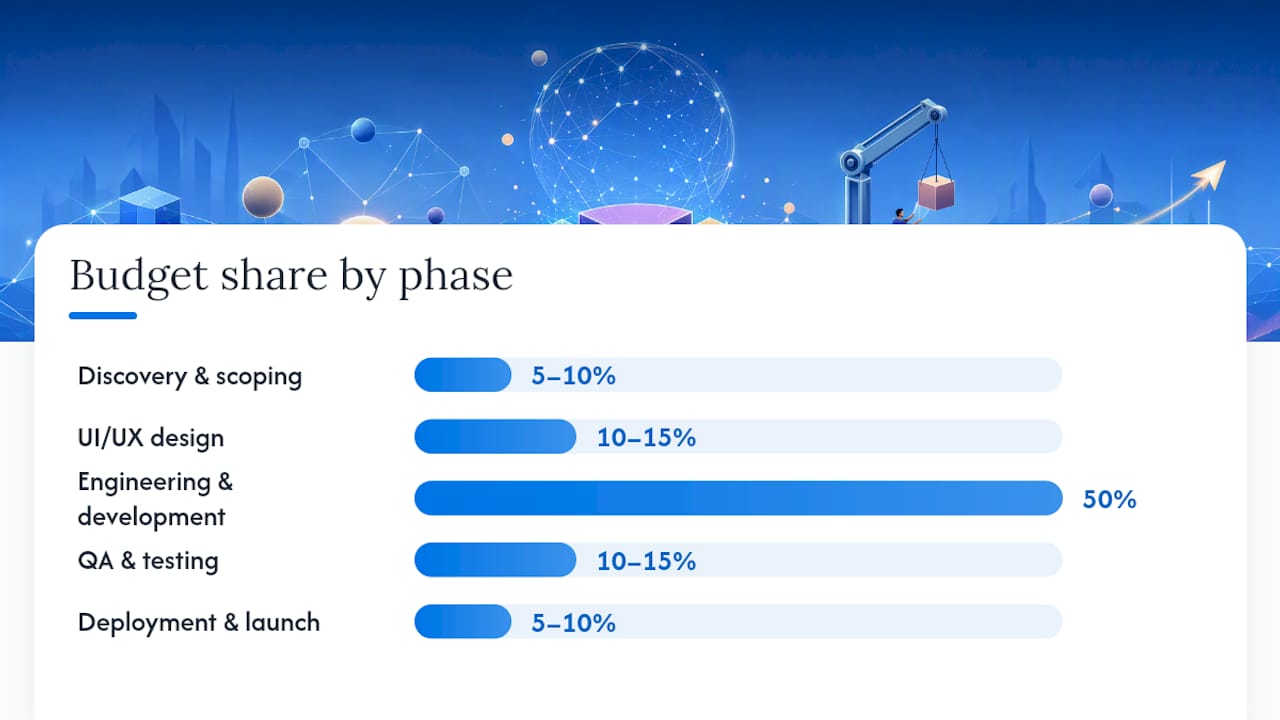
Timeline and cost move together, but not in a straight line. Discovery and design tend to eat a smaller percentage of the budget than people expect, while engineering and QA absorb the bulk of it.
| Phase | Percent of Total Budget | What Happens |
|---|---|---|
| Discovery and scoping | 5–10% | Requirements gathering, technical planning, architecture decisions |
| UI/UX design | 10–15% | Wireframes, prototypes, usability testing |
| Engineering and development | 50% | Core build, integrations, iterative feature delivery |
| QA and testing | 10–15% | Functional testing, security review, performance testing |
| Deployment and launch | 5–10% | Infrastructure setup, data migration, go-live support |
Three things reliably push timelines past their original estimate: integrations that turn out to need custom middleware, slow client-side decision making on design or feature tradeoffs, and data migration efforts that surface messier legacy data than anyone expected. If you want to compress a timeline without cutting corners, the most reliable lever is running design and early backend architecture in parallel rather than sequentially, and locking decision-makers into a fixed weekly review cadence so approvals don’t stall the sprint.
Who Should Build Your Software: In-House, Agency, or Freelancer?
The delivery model you choose affects cost as much as any feature on your list, and the tradeoffs are rarely obvious until you’re a few months into a project.
An in-house team gives you the most control and the deepest institutional knowledge, but it’s the slowest and most expensive path to get started, since hiring, onboarding, and tooling take months before a line of production code gets written. A boutique agency offers faster ramp-up and specialized expertise for a defined project, though capacity can be limited if your scope grows mid-engagement. An enterprise consultancy brings governance, security rigor, and scale, generally at a premium price that reflects the overhead of larger teams and formal processes. Offshore teams offer the lowest hourly rates but require strong project management discipline to avoid communication gaps and quality drift. Freelancers can be a reasonable fit for small, well-defined tasks, but they carry the highest risk for anything requiring sustained, coordinated delivery.
| Delivery Model | Relative Cost | Speed to Start | Ownership/Control | Risk Profile |
|---|---|---|---|---|
| In-house team | Highest | Slowest | Full | Low long-term, high upfront |
| Boutique agency | Moderate to high | Fast | Shared | Moderate |
| Enterprise consultancy | High | Moderate | Shared, strong governance | Low |
| Offshore team | Low | Fast | Shared | Higher without strong PM |
| Freelancer | Lowest | Fastest | Minimal | Highest for complex work |
A hybrid approach, where your own product manager directs a mix of internal staff and augmented external engineers, often gives the best balance of cost control and continuity, particularly when you already have technical leadership but need more hands for a defined build cycle.
When you’re reading proposals, a few signals separate a serious vendor from a risky one:
- A detailed breakdown of hours by phase, not just a single lump-sum number.
- Clear language about who owns the intellectual property once the project ships.
- A documented process for handling change requests without renegotiating the entire contract.
- Named team members with relevant experience, not just generic role titles.
How Do You Get an Accurate Custom Software Estimate?
An accurate quote depends far more on what you bring to the first conversation than on which vendor you choose. Here’s the preparation checklist that consistently produces tighter, more reliable estimates.
- Write down the business outcome you’re trying to achieve, not just the features you imagine needing.
- Map your core workflows step by step, including exceptions and edge cases.
- List every system the new software needs to integrate with, along with API documentation if you have it.
- Gather sample data, especially if migration from a legacy system is involved.
- Document any compliance or security requirements up front (HIPAA, SOC 2, PCI DSS).
- Define your success metrics or KPIs so the vendor understands what “done” looks like.
- Set a realistic timeline constraint and a hard budget ceiling before the first call.
Once you’re comparing quotes, the questions you ask matter as much as the checklist you bring:
- What does your discovery process look like, and how long does it take?
- What exactly is included in the deliverable, and what counts as a change order?
- Who owns the source code and intellectual property after delivery?
- What warranty or bug-fix period follows launch?
- What does ongoing maintenance cost, and is it optional or built in?
- What does your proposed team composition look like, by role and seniority?
A useful scoping guide can help you turn a rough idea into the kind of documented brief vendors need to quote accurately. When you have three quotes in hand, treat wide variance as a signal to ask more questions, not a reason to pick the cheapest number. A bid that’s dramatically lower than the others usually means the vendor scoped less, not that they’re more efficient. Watch for vague deliverable language, no mention of QA or testing time, and hourly rates with no estimated hour count attached.
To reduce cost or risk without gutting your project, three approaches consistently work: build a true MVP first and add features in a second phase once you have real usage data, use pre-built components (authentication, payment processing, cloud infrastructure) instead of custom-building solved problems, and insist on phased delivery with fixed checkpoints so cost overruns get caught in month two, not month ten.
What Do Industry Benchmarks Say About Custom Software Cost?
Every number in this article should be checked against a broader market picture, because a single vendor’s quote means little without context for where it falls relative to the industry as a whole.
| Benchmark | Figure | Source |
|---|---|---|
| Average project cost | ~$132,480 | Clutch |
| Average monthly project spend | ~$10,209 | Clutch |
| Typical delivery timeline | ~13 months | Clutch |
| Median startup/SME budget | $8,000–$25,000 | Getprojects |
| Recommended annual maintenance | 15–20% of build cost | LinkTech Solutions |
Statistic Callout: Statista’s market outlook documents continued growth in global application development software and IT services revenue, a trend that keeps upward pressure on vendor rates as demand for skilled engineering talent outpaces supply in most regions.
What this means depends heavily on who you are. A startup founder with an $8,000 to $25,000 budget is almost certainly building a narrow MVP or validating a single workflow, and should scope accordingly rather than chasing enterprise-grade features on a fraction of the typical spend. An enterprise buyer looking at the $132,480 average should treat that figure as a floor, not a ceiling. Once you’re integrating legacy systems, layering in compliance, or building at real production scale, six-figure averages routinely stretch into seven figures, which is exactly where Codestringers’ large-enterprise band of $400,000 to $1.5 million starts to apply.
What I’ve Learned From Reviewing Hundreds of Software Quotes
The biggest misconception buyers walk in with is that a lower quote means a better deal. It almost never does. A quote that’s 40 percent below the others usually means the vendor priced against a thinner interpretation of your requirements, not that they found a more efficient way to build the same thing. The gap shows up later, in change orders, in scope disputes, in a launch date that slips because nobody scoped the data migration properly.
The conventional wisdom says get three quotes and pick the middle one. I’d push back on that. Get three quotes, but spend more time comparing what’s included in each than comparing the dollar figure at the bottom. A $90,000 quote with a documented QA process, named team members, and a clear IP ownership clause is worth more than a $70,000 quote that’s vague on all three.
What people consistently underestimate is how much a good discovery process saves them, not in dollars spent on discovery itself, but in dollars not spent fixing a scope mistake six months into a build. That 40 to 80 percent cost inflation from poor scope definition isn’t a rare failure case. It’s the default outcome when a vendor starts coding against an incomplete brief. The fix isn’t more negotiation leverage. It’s a better first conversation.
Get a Scoped Estimate for Your Custom Software Project
You’ve seen the ranges, the factors, and the pricing models. What most buyers actually need next isn’t another spreadsheet of averages, it’s a straight answer for their specific project. That’s the gap Seattlesoftwaredevelopers is built to close: instead of guessing where your idea lands in a six-figure range, you get a discovery conversation that turns your requirements into a real number, backed by a team that’s built for enterprise-grade governance and security from day one.
Seattlesoftwaredevelopers works across healthcare, finance, and education, industries where compliance and legacy integration aren’t optional extras but core requirements, and structures every engagement around a few things that directly answer the questions raised in this article:
- A documented discovery and scoping process that produces an accurate estimate before you commit to a build.
- Security and governance built into the architecture from the first sprint, not bolted on after a compliance review flags a gap.
- Full-cycle development plus staff augmentation, so you can scale a team up or down without renegotiating a new vendor relationship.
- Regular demos and staged delivery, so budget overruns get caught at the checkpoint, not at launch.
If you’re weighing a custom build against a rough budget range and want a number you can actually plan around, start a scoped discovery conversation and bring the checklist from this article. That single step turns a guess into a plan.
Sources
What is the average cost of custom software development?
How much does a simple custom app cost?
A simple MVP or single-purpose app typically costs between $15,000 and $50,000, covering one or two core workflows, a basic interface, and minimal integrations, with delivery in 2 to 4 months.
Is custom software cheaper than buying off-the-shelf software?
Custom software usually has a higher upfront cost than off-the-shelf tools, but it avoids recurring per-seat licensing fees and can be built to match your exact workflows, which often makes it more cost-effective over a multi-year horizon.
How much should I budget for software maintenance each year?
Plan on spending 15 to 20 percent of your initial build cost annually on maintenance and support, with regulated industries like healthcare or finance often requiring a higher percentage due to compliance monitoring.
What’s the difference between fixed-price and time-and-materials pricing?
Fixed-price works best for well-defined, unlikely-to-change scopes, while time and materials fits projects where requirements will evolve, billing you for actual hours worked at an hourly or blended rate.
Recommended
- How to Scope a Custom Software Project | Seattle Software Developers
- Custom Software Solutions for Local Businesses: A Guide for Seattle Startups | Seattle Software Developers
- 7 Tips for Choosing The Best Software Developers in Seattle | Seattle Software Developers
- The Step-by-Step Process of Custom Software Development | Seattle Software Developers