


A dedicated development team is a long-term, cross-functional group of engineers, testers, and a product owner who work exclusively on your product, managed jointly by you and your vendor. Pick this model when you have ongoing feature work, a multi-year roadmap, or in-house skill gaps you can’t fill fast enough through direct hiring. It is the wrong choice for a one-off, tightly scoped project with a fixed deadline.
Software developer roles remain in steady demand, and the Bureau of Labor Statistics tracks the skill categories and duties that shape how vendors staff these teams. Hourly rates vary sharply by region, according to Statista, which is why budgeting for a dedicated team looks nothing like quoting a fixed-price project. Gartner also flags distributed team governance as one of the defining operational challenges leaders face when they scale technical capacity outside a traditional office.
Three scenarios make the model pay off:
- Scaling an existing product team without a six-month hiring cycle.
- Handling long-term maintenance and support for a system you can’t afford to under-staff.
- Turning around a stalled product with fresh ownership and accountable delivery.
Key Takeaways
A dedicated development team works best for long-term, evolving product work where ownership, continuity, and flexible capacity outweigh the cost predictability of a fixed-price contract.
| Point | Details |
|---|---|
| Match the model to the need | Choose dedicated teams for ongoing roadmaps, not one-off projects with fixed scope. |
| Budget with contingency | Add contingency for ramp-up months in your first two quarters. |
| Vet vendors on stability | Prioritize staff turnover, security posture, and domain experience over price alone. |
| Govern with real KPIs | Track cycle time, sprint predictability, and escaped defects on a weekly and monthly rhythm. |
| Plan the exit before you start | Require documented handover, code ownership transfer, and notice periods in the contract. |
| Consider Seattle Software Developers | Offers role-matched dedicated teams with governance and security practices built for regulated industries. |
Table of Contents
- What Is a Dedicated Development Team and When Do You Need One?
- Who Belongs on a Dedicated Development Team?
- How Much Does a Dedicated Development Team Cost?
- What Are the Benefits and Risks of the Dedicated Team Model?
- How Do You Choose and Hire the Right Dedicated Team?
- How Should You Onboard and Manage a Dedicated Team?
- What Contract, Security, and IP Terms Should You Require?
- How Do You Scale, Transition, or Offboard a Dedicated Team?
- What KPIs Should You Track to Govern a Dedicated Team?
- How Has Seattle Software Developers Delivered on a Dedicated Team Engagement?
- How Seattle Software Developers Helps You Build a Dedicated Team That Lasts
- Frequently Asked Questions
- Sources
What Is a Dedicated Development Team and When Do You Need One?
A dedicated development team is a group of specialists who work only on your product, embedded with your business the way an internal team would be, but employed and managed operationally by an external partner. You get direct input into hiring, daily priorities, and technical direction. The vendor handles recruitment, payroll, infrastructure, and backup staffing.
This differs meaningfully from the three models most leaders default to:
- In-house hiring gives you full control but takes months to ramp and carries fixed overhead you can’t flex down.
- Fixed-price contracts offer cost predictability for a narrowly defined scope, but they punish any change in requirements with change orders and renegotiation.
- Staff augmentation fills individual skill gaps fast, but you’re managing individuals rather than a team with shared context and continuity.
- Dedicated teams trade some upfront predictability for ongoing flexibility, product ownership, and a team that retains institutional knowledge across sprints and quarters.
Use this checklist to see if the model fits your situation:
- ☐ Your product roadmap extends past six months with evolving requirements.
- ☐ You need the team to own outcomes, not just complete tickets.
- ☐ Scope will shift as you learn from users, not stay fixed.
- ☐ The work touches integrations, legacy systems, or compliance requirements that reward deep, continuous familiarity.
If none of those apply, a fixed-price engagement or a short-term contractor probably serves you better. A balanced look at outsourcing tradeoffs is worth reading before you commit either way.
Who Belongs on a Dedicated Development Team?
Team composition depends on your product stage, but most functioning dedicated teams share a common backbone: someone who owns priorities, people who build, people who verify quality, and someone who keeps the pipeline running.
Product manager or product owner sets priorities and translates business goals into a backlog. In interviews, listen for how candidates handle conflicting stakeholder requests. A strong answer describes a framework, not just “communication.”
Business analyst documents requirements and bridges technical and non-technical stakeholders. Ask for an example of a requirement that changed mid-project and how they handled the ripple effects.
Front-end and back-end developers build the product. Test them with a real architecture decision from your domain, not a whiteboard puzzle disconnected from your actual stack.
QA and automation engineers catch what developers miss and build repeatable test suites. A strong candidate talks about test coverage strategy, not just manual click-through testing.
DevOps engineer manages deployment pipelines and infrastructure reliability. Ask how they’ve handled a production incident under real traffic, not a hypothetical one.
UX/UI designer shapes the actual user experience, ideally embedded early rather than bolted on after development starts.
Tech lead or architect owns technical decisions and mentors the team, especially critical once the team exceeds five or six people.
| Team Size | Best Fit | Typical Composition |
|---|---|---|
| 3–4 people | MVP or early-stage product | PM, 2 developers, QA (part-time or shared) |
| 5 or 6 people | Mid-size product with active roadmap | PM, BA, 3–4 developers, QA, DevOps |
| larger teams | Enterprise module or platform | PM, BA, tech lead, 5+ developers, dedicated QA, DevOps, UX designer |
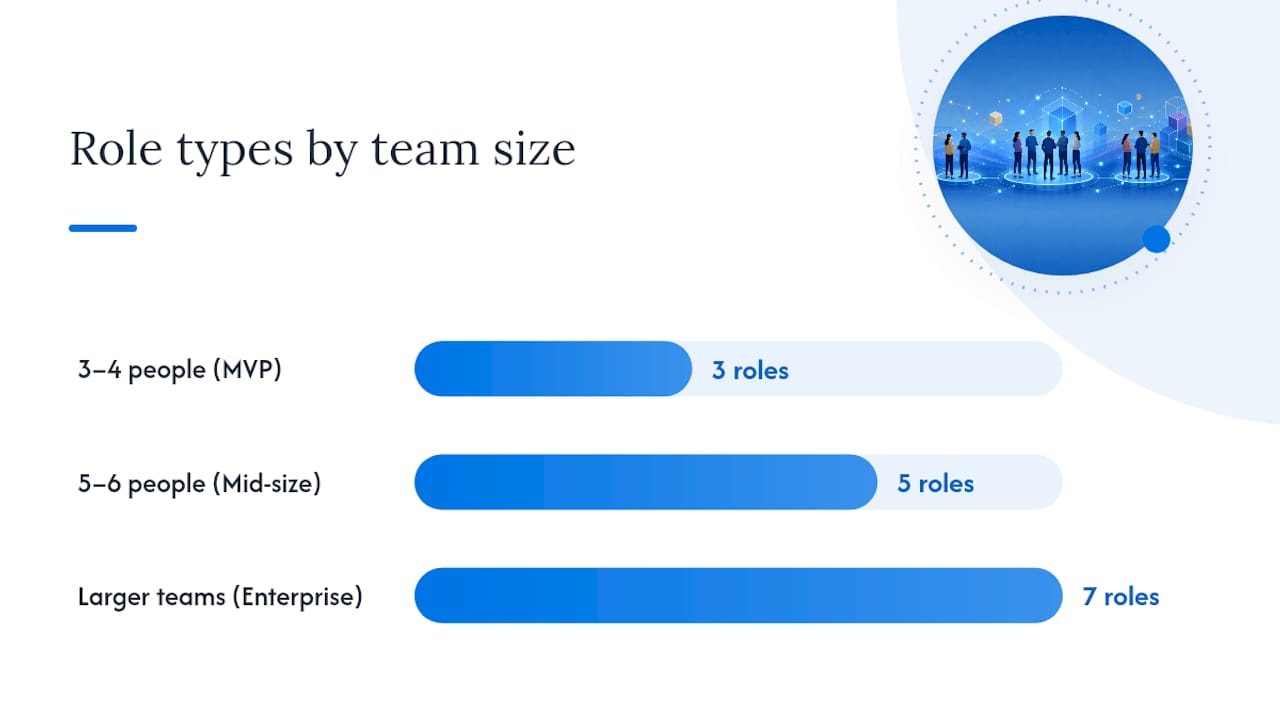
Smaller teams move faster on decisions but carry more single-person risk. Larger teams need explicit role clarity or coordination overhead eats your velocity gains.
How Much Does a Dedicated Development Team Cost?
Most dedicated teams bill through time and materials or a monthly retainer, not a fixed project fee. Time and materials means you pay for actual hours worked, which fits well when scope shifts sprint to sprint. A monthly retainer bundles a fixed team size into a predictable invoice, which suits leaders who want budget certainty without micromanaging hours. Blended rates, an average across the seniority mix on your team, simplify invoicing but can obscure who’s actually costing you the most.
This differs from fixed-price contracts, where the vendor absorbs scope risk in exchange for a rigid deliverable definition, usually with change orders priced separately and slowly.
Cost drivers worth modeling before you sign anything:
- Seniority mix. A team weighted toward senior engineers costs more per hour but ships fewer defects and needs less oversight.
- Location. Onshore, nearshore, and offshore rates diverge substantially, and Statista’s regional data shows the spread is wide enough to swing your annual budget by a significant margin depending on where your team sits.
- Tooling and infrastructure. Licensing for project management, CI/CD, and monitoring tools adds a recurring line item most first-time buyers forget to budget.
- Management overhead. A vendor’s project management and QA layer costs money even though it isn’t writing code, and it’s usually worth it.
Pro Tip: Build a 12-month budget with a 15 to 20 percent contingency line for the first two quarters. Ramp-up months always cost more than steady-state months because you’re paying for onboarding, tool setup, and knowledge transfer before the team hits full velocity. Treat month one and two as an investment period, not a billing anomaly.
What Are the Benefits and Risks of the Dedicated Team Model?
The dedicated model rewards you with ownership and continuity that transactional engagements can’t match, but each benefit carries a real risk you need a plan for.
Product ownership means the team understands your business context deeply enough to make good calls without constant hand-holding. The risk: that knowledge concentrates in a few people, and if they leave, you lose institutional memory overnight. Mitigate it with mandatory documentation standards and cross-training so no single engineer is a bottleneck.
Knowledge retention across sprints beats re-explaining context to a new contractor every few weeks. The risk is complacency, where a long-tenured team stops questioning old decisions. Counter it with quarterly architecture reviews that force a fresh look at technical debt.
Flexible capacity lets you scale the team up during a launch push and down during quieter months. The risk is that vendors sometimes resist scaling down because it hurts their revenue. Address this contractually with clear notice periods up front, not after a dispute starts.
Predictable capacity gives you a stable velocity baseline for planning. The risk is that predictability can mask stagnation if nobody is tracking whether output is actually improving. Watch for red flags: high staff turnover on your account, vague status reporting, or a slow, disorganized onboarding process. Any one of those is a signal to look elsewhere before you sign a longer commitment.
How Do You Choose and Hire the Right Dedicated Team?
Vendor selection determines almost everything downstream, so treat it with the same rigor you’d apply to a senior hire.
- Confirm business and domain fit first. A vendor with healthcare or fintech experience understands compliance constraints you’d otherwise have to teach from scratch.
- Check staff stability. Ask directly how long engineers typically stay on client accounts. High turnover kills the continuity that makes this model worth choosing.
- Review their security posture. Ask about access control policies, data handling practices, and whether they’ve supported clients through compliance audits.
- Request references from active clients, not just closed projects. An active client can tell you how the vendor handles friction in real time.
- Run a paid trial sprint before committing to a 12-month contract. Two to four weeks reveals communication habits no proposal document can.
Interview questions worth asking each role directly:
- To a developer candidate: “Walk me through a production bug you introduced and how you found it.” A strong answer owns the mistake and describes the fix process, not just the outcome.
- To a QA candidate: “How do you decide what to automate versus test manually?” Look for a risk-based rationale, not a blanket rule.
- To a PM candidate: “Describe a time scope changed mid-sprint. How did you communicate it?” A strong answer shows proactive stakeholder management, not just a status update.
Use a simple scorecard to compare vendors objectively:
- Domain experience (weight: high) — Have they built something like this before?
- Staff stability (weight: high) — What’s their average tenure on client accounts?
- Security and governance (weight: high) — Do they have documented access control and data handling policies?
- Communication clarity (weight: medium) — How structured is their reporting during the sales process itself?
- Cultural fit (weight: medium) — Does their working style match how your internal team operates?
Red flags that should end a conversation regardless of price: refusal to name specific team members before signing, vague answers about IP ownership, or an unwillingness to do a trial engagement. A practical guide to hiring a development partner covers additional evaluation signals worth reviewing before you shortlist anyone.
How Should You Onboard and Manage a Dedicated Team?
Onboarding sets the tone for everything that follows, and a structured 30/60/90 plan prevents the slow, frustrating ramp-up that sinks otherwise good engagements.
- Days 1 to 30: Discovery. The team reviews existing code, documentation, and business context. Expect a knowledge-transfer document and an initial backlog by the end of this window.
- Days 31 to 60: First deliverables. The team ships smaller, lower-risk features to validate their understanding of your codebase and your review process.
- Days 61 to 90: Full velocity. By this point, the team should be operating at a predictable sprint cadence with minimal hand-holding on routine work.
Day-to-day rhythm matters as much as the ramp. A daily standup keeps everyone synced on blockers. Sprint planning sets a two-week (or comparable) commitment. Regular demos let you see working software instead of trusting a status report, and retrospectives give the team a structured way to fix what isn’t working. Research on team leadership practices backs this kind of structured cadence as one of the clearest levers for improving distributed team performance.
Tooling matters too. A shared issue tracker, source control with clear branching conventions, an automated CI/CD pipeline, and living documentation (not a wiki nobody updates) keep a distributed team aligned without constant meetings. Enterprise collaboration practices become especially important once your team crosses six or seven people across multiple time zones.
What Contract, Security, and IP Terms Should You Require?
Your contract is the mechanism that protects your product long after the relationship ends, so treat these clauses as non-negotiable rather than optional add-ons.
- IP assignment stating explicitly that all code, designs, and documentation belong to you, not the vendor, on delivery.
- Scope of work defined clearly enough to serve as a reference point during disputes, even in a time-and-materials arrangement.
- Termination and transition terms specifying notice periods and what handover deliverables you’re owed if the relationship ends.
- NDAs and confidentiality clauses covering both the vendor’s company and every individual engineer on your account.
On security, require least-privilege access control so engineers only touch systems relevant to their work, multi-factor authentication on all production access, and centralized logging so you can audit who touched what and when. Ask how they handle vulnerability disclosure and whether they’ve supported clients through security audits before. Security practices for custom development are worth reviewing in detail if your product touches regulated data.
Sample SLA metrics to write into the contract: uptime commitments for any shared infrastructure services, response time windows for critical defects (often under four hours for severity-one issues), and a defined defect turnaround time for lower-priority bugs.
How Do You Scale, Transition, or Offboard a Dedicated Team?
Scaling and offboarding deserve the same planning rigor as the initial hire, because most of the risk in this model shows up at the edges of the engagement, not in the steady middle.
When scaling up, give the vendor real lead time, typically two to four weeks, so new hires can be onboarded properly rather than rushed. When scaling down, build overlap between departing and remaining team members so context doesn’t leave with the person.
A clean handover includes:
- Updated technical documentation covering architecture decisions and known issues.
- Runbooks for operational tasks like deployments and incident response.
- Explicit code ownership transfer so nothing sits in institutional limbo.
- A recorded walkthrough session, not just a document dump.
To retain critical knowledge during any staff change, require pair programming during transition periods and maintain a living decision log throughout the engagement, not just at the point someone leaves. Teams that document decisions as they happen lose far less when a key person exits.
What KPIs Should You Track to Govern a Dedicated Team?
Governance without measurable indicators is just hope. Track cycle time (how long a task takes from start to done), sprint predictability (percentage of committed work actually delivered), escaped defects (bugs that reach production), deployment frequency, and lead time for changes.
Set a reporting rhythm that matches the stakes: a weekly engineering summary for operational visibility, a monthly roadmap review to check strategic alignment, and a quarterly business outcomes review tying technical output back to revenue or user metrics. PMI’s research on agile practices links this kind of structured governance to materially higher project success rates.
A useful dashboard surfaces trend lines, not just snapshots. A sprint predictability score that’s been declining for three cycles in a row matters more than any single week’s number, and it’s usually your earliest warning sign of a team in trouble.
What Tech Stacks and Tools Do Dedicated Teams Typically Use?
Stack choices vary by product, but common patterns include React or Vue for front-end web work, Node.js, Python, or .NET for back-end services, and Swift or Kotlin for native mobile development.
- Issue tracking and backlog management (typically a Kanban or Scrum board tool).
- Source control with enforced pull-request review before merging.
- CI/CD pipelines that automate testing and deployment.
- Monitoring and alerting so incidents surface before customers report them.
Ask any vendor candidate how their toolchain integrates with your existing systems, not just what tools they prefer in isolation.
How Has Seattle Software Developers Delivered on a Dedicated Team Engagement?
A healthcare client approached Seattle Software Developers needing to modernize a legacy patient intake system while keeping it running under real production load. The engagement started with a five-person dedicated team: a product manager, two back-end developers, a QA engineer, and a DevOps specialist, scaling to eight people once the roadmap expanded into reporting and compliance modules.

Within the first 90 days, the team shipped an initial modernized module while maintaining the legacy system in parallel, avoiding the downtime that a full rebuild would have forced. Sprint predictability climbed as the team settled into a two-week cadence with weekly demos, giving stakeholders visibility into working software rather than status slides.
Two lessons generalize well beyond this engagement. First, running new and legacy systems in parallel, rather than attempting a hard cutover, dramatically lowers the risk of production incidents during a modernization project. Second, weekly demos build client trust faster than any written status report, because stakeholders see functioning software instead of taking someone’s word for progress.
What Do I Wish More Leaders Understood Before Hiring a Dedicated Team?
Most leaders underestimate how much of this model’s success depends on their own engagement, not just the vendor’s competence. A dedicated team performs only as well as the product direction you give it. If you show up to sprint reviews unprepared or let priorities shift weekly without explanation, even a strong team will drift.
The tension between speed and technical debt deserves more honesty than most vendors offer upfront. Every dedicated team will occasionally ship something faster by cutting a corner. What matters is whether your vendor flags that debt openly and schedules time to address it, rather than letting it silently accumulate until a rewrite becomes unavoidable.
Pro Tip: Ask your vendor to maintain a visible technical debt log, reviewed monthly. If they can’t produce one after three months, that’s a governance gap worth addressing immediately.
How Seattle Software Developers Helps You Build a Dedicated Team That Lasts
Seattle Software Developers gives you a dedicated team without the six-month hiring cycle or the guesswork of vetting an unfamiliar offshore vendor from scratch. You get a team built around your specific stack and industry, backed by security and governance practices proven across healthcare, finance, and education clients who can’t afford loose access control or vague IP terms.

That means role-matched engineers, a clear onboarding plan modeled on the 30/60/90 timeline above, and regular demos so you’re never waiting weeks for visibility into progress. If legacy integration or compliance is part of your challenge, that experience carries over directly instead of costing you a learning curve you’re paying for. Review the step-by-step custom software development process to see exactly how an engagement unfolds from discovery to delivery, then reach out for a discovery call to scope your team composition and timeline.
Frequently Asked Questions
What’s the difference between a dedicated development team and staff augmentation?
Staff augmentation adds individual specialists to your existing team to fill a skill gap. A dedicated development team is a complete, self-contained unit with its own product manager, developers, and QA, working as a cohesive group rather than as individually managed contractors.
How long does it take to onboard a dedicated development team?
Most teams reach full velocity within 60 to 90 days, following discovery, initial small deliverables, and a ramp to a stable sprint cadence.
Who owns the code and intellectual property in a dedicated team engagement?
Your contract should state explicitly that all code, documentation, and designs belong to your business on delivery, not the vendor, regardless of billing model.
Is a dedicated development team more expensive than hiring in-house?
It depends on your timeline. In-house hiring carries lower long-term per-hour cost but months of recruiting overhead and fixed costs during slow periods; a dedicated team ramps faster and flexes with your workload, which often offsets a higher blended rate.
Sources
Recommended
- Software Development For All Businesses | Seattle Software Developers
- Hiring a Software Development Partner | Seattle Software Developers
- How Seattle Software Developers Drive Business Growth? | Seattle Software Developers
- The Step-by-Step Process of Custom Software Development | Seattle Software Developers