


A HIPAA-compliant custom software project requires a risk-based implementation of the HIPAA Security Rule mapped to concrete engineering controls, plus documented risk management and a signed Business Associate Agreement. If a development partner can’t produce those artifacts before code ships, you have a liability, not a solution.
Any vendor or staff augmentation partner building software that touches protected health information must deliver on five fronts: mapped technical safeguards under 45 CFR §164.312, documented risk-based decisions for every “addressable” specification, a written BAA before any development starts, a secure software development lifecycle with evidence to prove it, and audit artifacts an OCR investigator could review without a scramble.
The non-negotiable engineering controls look like this:
- Unique user IDs and role-based access control for every account touching ePHI
- Comprehensive audit logging that captures who accessed what, when, and from where
- Encryption for data at rest and in transit, using current TLS standards
- Integrity controls that detect unauthorized alteration of records
- Authentication strong enough to survive a credential-stuffing attempt (multifactor, ideally SSO-integrated)
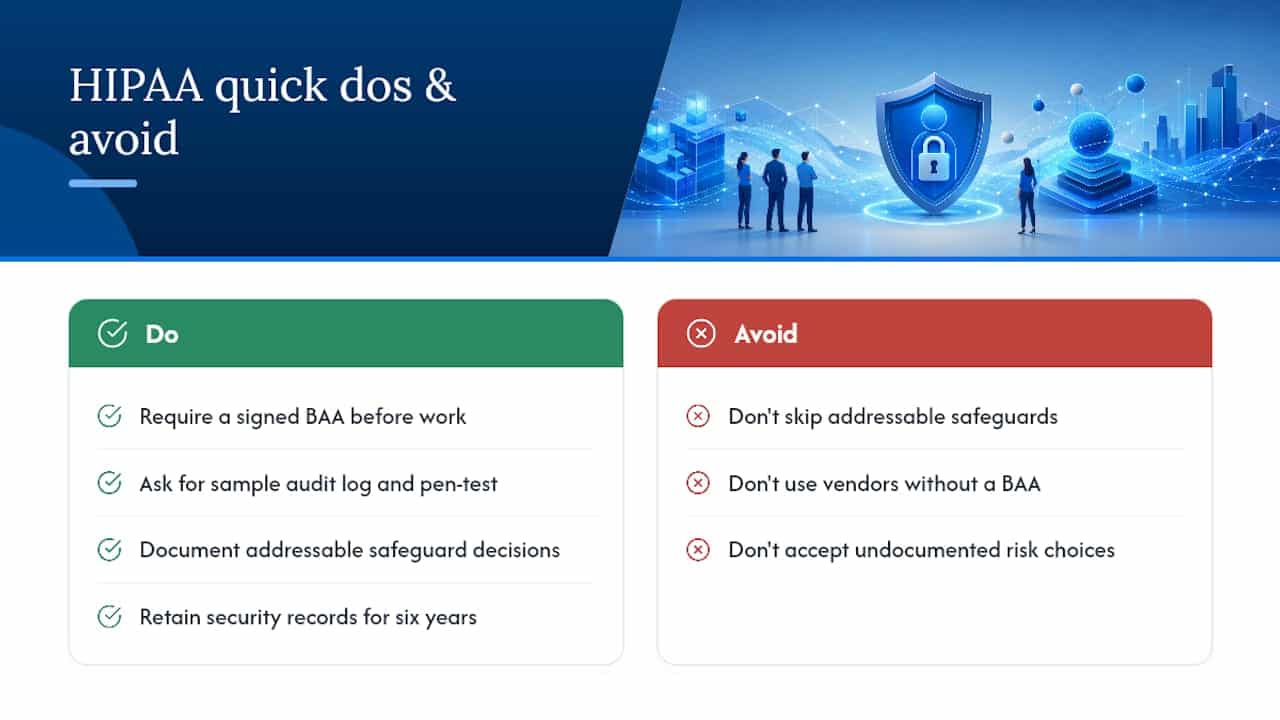
Pro Tip: Before you sign anything, ask the vendor for a compliance deliverables checklist and their standard BAA template. If they hesitate on either, that’s your answer.
“Addressable” doesn’t mean optional. It means the vendor must implement the control or document, in writing, a risk-based reason for the alternative they chose instead.
Key Takeaways
HIPAA-compliant custom software succeeds when mapped technical safeguards, documented risk decisions, secure SDLC evidence, and a signed BAA are in place before development begins, not after.
| Point | Details |
|---|---|
| Request the BAA first | Sign a Business Associate Agreement before any development work starts, not after launch. |
| Verify addressable controls | Require written justification for any addressable specification the vendor doesn’t implement directly. |
| Confirm secure SDLC evidence | Ask for SAST/DAST results, code review records, and penetration test reports tied to your project. |
| Scope risk assessment broadly | Include teleworkers, third-party access, and connected medical devices in the assessment scope. |
| Choose a partner with proof | Seattlesoftwaredevelopers provides BAAs, documented architecture, and healthcare integration experience on request. |
Table of Contents
- What Does HIPAA Compliant Software Actually Require From Developers?
- What Secure Development Process Should a HIPAA Vendor Follow?
- What Should a HIPAA Risk Assessment and BAA Cover?
- What Deliverables Prove Compliance Readiness?
- How Do You Choose the Right HIPAA Development Partner?
- How Seattle Software Developers Delivers HIPAA-Capable Software
- What Do Vendors Get Wrong Most Often on HIPAA Projects?
- Get a HIPAA-Ready Software Partner Without the Guesswork
- Primary Sources for Vendor Evaluation and Audits
- Frequently Asked Questions
- Sources
What Does HIPAA Compliant Software Actually Require From Developers?
The HIPAA Security Rule doesn’t hand developers a build spec. It hands them a framework, and NIST SP 800-66 Revision 2 exists specifically to translate that framework into something an engineering team can implement, mapping Security Rule language to NIST Cybersecurity Framework subcategories and SP 800-53 controls.
45 CFR §164.312 breaks technical safeguards into five categories, and each one carries direct engineering consequences.
Access control means unique user identification for every account, plus emergency access procedures. Automatic logoff and encryption of stored data are addressable, which does not mean skippable. Audit controls require logging mechanisms that record activity on systems containing ePHI, comprehensive enough to reconstruct who touched a record and when. Integrity controls must confirm ePHI hasn’t been improperly altered, often through checksums or signed transactions. Authentication verifies that a person accessing data is who they claim to be, and modern implementations lean on multi-factor authentication and SSO. Transmission security protects ePHI moving across networks, and while encryption in transit is technically addressable, practical checklist guidance treats end-to-end TLS as close to mandatory for any ePHI in motion.
| Standard | Developer control | Evidence to request |
|---|---|---|
| Access control | Unique IDs, RBAC, emergency access | User provisioning logs, role matrix |
| Audit controls | Centralized logging, tamper-resistant | Sample audit log export |
| Integrity | Checksums, signed transactions | Data integrity test results |
| Authentication | MFA, SSO integration | Auth architecture diagram |
| Transmission security | TLS across all ePHI paths | Network diagram, TLS config |
Responsibility for these controls splits across three layers. Application-level code typically owns access control logic and audit event generation. The hosting platform, whether AWS, Azure, or Google Cloud, handles much of the encryption-at-rest infrastructure and network segmentation. Infrastructure and DevOps teams own key management, patching cadence, and monitoring. A vendor who can’t explain which layer owns which control hasn’t actually built HIPAA-aware medical software solutions before.
What Secure Development Process Should a HIPAA Vendor Follow?
Secure SDLC isn’t a slide in a sales deck. It’s a sequence of checkpoints that produces evidence at every stage, and a developer-focused HIPAA compliance guide lays out the practical steps: secure authentication, access limitation, confidentiality and integrity controls, documented incident response, and contingency planning built in from the start rather than bolted on later.
A HIPAA-capable engineering process should include:
- Threat modeling during design, before a single line of code is written
- Static application security testing (SAST) integrated into every pull request
- Dynamic application security testing (DAST) against staging environments
- Peer code review with a security-focused checklist, not just a functionality check
- Dependency and software composition scanning to catch vulnerable libraries
- Secrets management through a vault, never hardcoded credentials
- Secure CI/CD pipelines with signed builds and restricted deployment permissions
| SDLC phase | Tooling category | What it catches |
|---|---|---|
| Design | Threat modeling frameworks | Architectural gaps before build |
| Build | SAST scanners | Code-level vulnerabilities |
| Test | DAST tools | Runtime and API weaknesses |
| Dependencies | SCA scanners | Vulnerable third-party libraries |
| Deploy | CI/CD security gates | Unsigned or unreviewed releases |
| Runtime | Monitoring and detection | Anomalous access patterns |
Operationally, expect hardened deployment pipelines, strict configuration management, centralized key management, and continuous logging paired with scheduled penetration testing, not a one-time engagement three years ago.
Pro Tip: Ask whether security gates run inside the sprint cadence or get bolted on right before release. Integrating them into CI/CD means compliance evidence accumulates automatically as development happens, instead of triggering a scramble the week before an audit.
What Should a HIPAA Risk Assessment and BAA Cover?
Risk assessment scope has to extend past the application itself. NIST SP 800-66 specifies the assessment must account for physical and logical boundaries, teleworkers, removable media, connected medical devices, and any third party with remote access to systems carrying ePHI. Questionnaire-based tools like the HHS Security Risk Assessment Tool are a reasonable starting point for smaller organizations, but enterprise buyers should expect their vendor to pair that with actual vulnerability scanning, not a checklist alone.
Risk management then follows a repeatable sequence:
- Identify assets and data flows carrying ePHI, inbound and outbound
- Analyze threats and vulnerabilities against those flows
- Prioritize risks by likelihood and impact
- Select controls, implementing required specs and documenting decisions on addressable ones
- Track remediation to closure with dated evidence
The BAA is where legal and technical obligations meet. A properly written BAA defines the vendor’s permitted uses of ePHI, flows those same obligations down to any subcontractor, sets incident notification timelines, and specifies what happens to ePHI when the engagement ends. Request the risk register, the mitigation plan, and written justification for any addressable specification the vendor chose not to implement outright.
What Deliverables Prove Compliance Readiness?
Documentation is what separates a defensible security posture from a lucky one. Audit readiness depends on system-generated audit logs, access review records, and vulnerability scan reports tied to specific, tracked remediation, not vague assurances that “everything’s fine.”
At project handoff, your vendor should hand over:
- Architecture diagrams and data-flow maps showing every ePHI touchpoint
- Written policies and procedures covering access, retention, and disposal
- Risk assessment reports with documented control decisions
- SAST and DAST test results from the build cycle
- Penetration test reports with remediation status for each finding
- Sample audit logs and access-review records
- Data retention and disposal policies
- The signed BAA and any subcontractor flow-down agreements
- Incident response runbooks
Retention matters as much as content. Keep these records for at least six years per Security Rule documentation requirements, stored in a format your compliance team can actually query, not buried in a PDF nobody can search.
Pro Tip: Build a shared, versioned repository for these deliverables from day one of the engagement. Retrofitting documentation after launch costs far more than maintaining it as you go.
How Do You Choose the Right HIPAA Development Partner?
Evaluation starts with a simple test: will they sign a BAA before development begins, without redlining away their own accountability? Beyond that, look for documented secure SDLC practices, real experience with ePHI flows and EHR integrations using FHIR or HL7, and independent security artifacts like SOC 2 reports or ISO 27001 certification where applicable.
During technical interviews, ask direct questions: “Walk me through your last penetration test and what you remediated.” “Show me a redacted audit log from a prior healthcare project.” “How do you segregate production ePHI from staging and development environments?” Vague answers are the tell.
Red flags worth walking away from:
- Refusal or reluctance to sign a BAA
- No audit logs, test reports, or risk assessment documentation on request
- Unclear separation between production data and lower environments
- No documented risk management process
- Minimal or absent audit logging
- Fuzzy incident response timelines
Timeline and cost scale with the scope of ePHI touched, the number of regulated interfaces (each EHR or HL7/FHIR integration adds testing and mapping work), penetration testing and remediation cycles, hosting architecture decisions, and ongoing maintenance commitments after launch. A single-module pilot with one EHR integration moves faster than a full platform modernization touching a dozen data flows, and buyers should scope accordingly rather than assuming a flat rate applies.
How Seattle Software Developers Delivers HIPAA-Capable Software
An engagement built for ePHI needs specific roles at the table: an engineering lead accountable for architecture decisions, a security engineer running SAST/DAST and coordinating penetration tests, a compliance liaison tracking risk assessment outputs, a QA lead validating integrity and access controls, and a product manager keeping the buyer’s internal team looped into every checkpoint.
Seattlesoftwaredevelopers structures HIPAA-focused projects around recurring demos and documented milestones, so compliance evidence, architecture diagrams, runbooks, risk assessment updates, accrues throughout the build instead of arriving as a rushed afterthought before go-live. That approach draws on experience across healthcare, finance, and education, including EHR integration work and personalized medicine platforms that depend on the same access control and audit logging discipline HIPAA demands.
Ask any partner for proof, not promises: a signed BAA, an architecture diagram with data flows labeled, and a penetration test report with remediation status. If they can produce all three in the first meeting, you’re talking to the right team.
Buyers evaluating a partner should request a discovery call scoped around their specific ePHI flows and existing systems, not a generic sales pitch.
What Do Vendors Get Wrong Most Often on HIPAA Projects?
The most common failure isn’t a missing encryption library. It’s treating HIPAA as a checkbox exercise instead of a risk-based discipline that requires judgment at every design decision. I’ve seen vendors implement every “required” control perfectly while waving off addressable specifications with a shrug instead of a documented risk analysis, and that gap is exactly where OCR audits find trouble.
The second mistake is worse: security work that happens entirely at the end of a project. A team that runs its first penetration test the week before launch isn’t practicing secure SDLC, it’s hoping. Security gates belong inside sprint cadence from day one, because remediation costs climb sharply the later a vulnerability surfaces in the build cycle.
Buyers also underestimate how much a BAA reveals about a vendor’s maturity. A partner who negotiates hard to narrow their own responsibility, rather than clarifying it, is telling you how they’ll behave during an actual incident. Seattlesoftwaredevelopers’s approach of putting the BAA and risk assessment cadence on the table at project scoping, not after contracts are signed, reflects the discipline this work actually demands.
Get a HIPAA-Ready Software Partner Without the Guesswork
Seattlesoftwaredevelopers offers custom software development and staff augmentation built around the exact controls covered above, access management, audit logging, encryption, secure SDLC, delivered by teams with direct experience on EHR integrations and ePHI data flows.

An initial engagement starts with discovery: mapping your existing systems, scoping a risk assessment specific to your data flows, and producing a compliance deliverables list before a single line of code gets written. You’ll get a proposed timeline estimate based on the number of regulated interfaces and integration points involved, not a generic quote pulled from a rate card. Seattlesoftwaredevelopers provides a BAA as part of contract negotiation, so the legal foundation is in place before development starts, not retrofitted after.
If you’re evaluating a partner for a new build or a legacy system that needs to catch up to current security standards in custom software development, start with a discovery conversation. Review Seattlesoftwaredevelopers’s software development process or reach out directly through Seattlesoftwaredevelopers to scope your project.
Primary Sources for Vendor Evaluation and Audits
Enterprise buyers evaluating a development partner should keep these references on hand during contract negotiation and technical due diligence.
- 45 CFR §164.312: the primary legal text defining required and addressable technical safeguards; use it to check a vendor’s control list against the actual regulation.
- NIST SP 800-66 Revision 2: translates the Security Rule into engineering-ready control mappings against NIST CSF and SP 800-53; useful when a vendor’s documentation references NIST frameworks.
| Source | Best used for |
|---|---|
| 45 CFR §164.312 | Confirming required vs. addressable safeguards in vendor proposals |
| NIST SP 800-66 Rev. 2 | Cross-checking a vendor’s control mapping and documentation practices |
Frequently Asked Questions
What makes software HIPAA compliant?
Software becomes HIPAA compliant when its access control, audit logging, encryption, integrity, and authentication mechanisms map to 45 CFR §164.312, backed by documented risk assessments and a signed BAA with the development partner.
Does a software vendor need to sign a BAA?
Yes. Any vendor or staff augmentation partner that creates, receives, maintains, or transmits ePHI on your behalf must sign a Business Associate Agreement before development begins.
What’s the difference between required and addressable safeguards?
Required safeguards must be implemented exactly as specified. Addressable safeguards must be implemented if reasonable, or replaced with a documented, risk-based alternative, never simply skipped.
How long should HIPAA compliance records be retained?
Security Rule documentation, including risk assessments, policies, and audit records, should generally be retained for at least six years from creation or last effective date.
What should I ask a vendor before signing a contract?
Ask for a sample audit log, a recent penetration test report, their standard BAA template, and a specific example of how they documented an addressable safeguard decision on a past healthcare project.
This article is general information, not a substitute for advice from a qualified lawyer. Consult a qualified legal professional about your own circumstances before acting on anything here.
Sources
- Implementing the Health Insurance Portability and Accountability Act (HIPAA) Security Rule: A Cybersecurity Resource Guide
- HIPAA Technical Safeguards List (164.312): Quick-Reference Checklist for Access, Audit, Integrity, Authentication & Transmission Security