


Every legacy system in your portfolio needs a decision, not a default: retain, retire, rehost, replatform, refactor, or rearchitect. Most enterprise programs land on a mix of three to five of these approaches across their estate rather than a single strategy applied everywhere, and Microsoft’s cloud adoption guidance makes that point directly, matching the approach to the workload’s business goals and constraints, not the other way around.
The next action is simple to state and harder to skip. Run a prioritized application inventory, score each system against risk and business value, then pick one small, low-risk, high-value candidate as your Phase 1 pilot. AWS’s prescriptive guidance on phased modernization recommends exactly this sequence: assess, build a minimum viable product, then scale using a split-and-seed model where a core team seeds new teams with proven patterns.
Here’s where most technology leaders should start, based on the workload in front of them:
- Facing a data center exit deadline? Start with rehost. It moves infrastructure fast with minimal code change.
- Have a stable app but rising cloud costs? Replatform it to a managed service without touching the core logic.
- Sitting on code with strong test coverage but poor performance? Refactor is the safer bet than a rebuild.
- Running a monolith that blocks every release? Rearchitect using the strangler fig pattern instead of a big-bang rewrite.
- Maintaining a system three people understand and nobody uses? Retire it before spending a dollar modernizing it.
This is the same 7 Rs decision model that shows up across most credible modernization frameworks, and the reason it persists is straightforward: per-system scoring beats a program-wide mandate almost every time.
Key Takeaways
Legacy modernization succeeds when every workload gets a deliberate strategy decision, driven by a scored inventory, executed through a phased pilot, and governed by clear go/no-go gates between phases.
| Point | Details |
|---|---|
| Score before you strategize | Build a weighted inventory covering criticality, coupling, and test coverage before assigning any of the six modernization strategies. |
| Start small on purpose | Pick a low-risk, high-value pilot for Phase 1, typically four to eight weeks, before committing to program-wide rollout. |
| Protect revenue-critical systems | Use the strangler fig pattern and API facades to replace high-risk systems without a big-bang cutover. |
| Set gates, not just goals | Define technical, quality, and budget gates leadership must approve before each phase begins. |
| Get expert scoping support | Seattlesoftwaredevelopers helps enterprise teams assess legacy portfolios and execute Phase 1 pilots with governance built in from day one. |
Table of Contents
- What Are the Main Legacy Modernization Strategies?
- How Do You Choose the Right Strategy for Each Workload?
- What Does a Phased Modernization Roadmap Look Like?
- Which Execution Patterns Reduce Modernization Risk?
- What Are the Biggest Risks and How Do You Measure Success?
- Where Do Common Enterprise Modernization Strategies Apply?
- How Do You Build a Reusable Phase 1 Pilot Plan?
- What Do We See Go Right and Wrong in Real Modernization Projects?
- How Seattlesoftwaredevelopers Supports Your Modernization Program
- Where to Read More on Legacy Modernization Strategies
- Frequently Asked Questions
- Sources
What Are the Main Legacy Modernization Strategies?
Six strategies cover nearly every legacy modernization decision an enterprise will face, and understanding what separates them determines whether your program delivers value in months or drags on for years without a clear return.
Retain means leaving a system exactly as it is, at least for now. This isn’t neglect. It’s a deliberate call that a workload’s risk, cost, or business value doesn’t justify near-term investment. Retain candidates typically get revisited annually.
Retire means shutting a system down. Portfolio audits routinely turn up applications with overlapping functionality, and industry analysis on legacy upgrades suggests a meaningful share of any enterprise inventory, often somewhere between 15% and 30%, is a retirement candidate once someone actually looks. Retiring those first shrinks the scope of everything downstream.
Rehost, commonly called lift-and-shift, moves an application to new infrastructure with little or no code change. Microsoft’s modernization guidance frames rehost and replatform as the fastest paths to cloud adoption when the priority is speed, not architectural improvement.
Replatform goes a step further: you move to a managed service, such as a managed database or container platform, without rewriting the application’s core logic. It’s the middle ground between “don’t touch it” and “rebuild it.”
Refactor restructures code internally to improve maintainability, performance, or security while preserving external behavior. It only works safely when characterization tests exist first, since refactoring without test coverage risks silently changing what the system does.
Rearchitect or rebuild replaces the underlying architecture entirely, often decomposing a monolith into services. It delivers the most business impact and carries the most risk and cost.
Repurchase swaps a custom or legacy system for a SaaS product, which sidesteps engineering effort entirely but requires accepting a vendor’s data model and roadmap.
| Strategy | When to use | Effort / engineering cost | Risk & rollback complexity | Time-to-value | Business impact | Example use case |
|---|---|---|---|---|---|---|
| Retain | Stable, low-risk, rarely touched | Minimal | Low | Immediate | None (deferred) | Internal reporting tool used quarterly |
| Retire | Duplicate or unused functionality | Low | Low | Immediate | Cost savings | Redundant legacy CRM after SaaS adoption |
| Rehost | Urgent data center exit, tight timeline | Low | Low, easy rollback | Weeks | Infrastructure cost, agility | Lift VM-based app to cloud IaaS |
| Replatform | Stable app, need managed services | Moderate | Moderate | Weeks to months | Ops efficiency, reduced maintenance | Move on-prem database to managed cloud DB |
| Refactor | Good test coverage, performance or security gaps | Moderate to high | Moderate, needs strong tests | Months | Maintainability, security posture | Modularizing a monolithic billing engine |
| Rearchitect/rebuild | Business-critical, needs scale or agility | High | High, needs incremental rollout | Months to a year+ | Highest, enables new capabilities | Decomposing an order-management monolith |
| Repurchase | Commodity function, SaaS fits well | Low to moderate (integration) | Moderate, vendor lock-in risk | Weeks to months | Reduced maintenance burden | Replacing homegrown HR system with SaaS |
A few practical signals worth internalizing before you commit to a strategy:
- Choose refactor when automated test coverage already exists; without it, you’re refactoring blind.
- Choose rehost when the deadline is external, like a data center lease expiring, not internal preference.
- Choose rearchitect only when the system’s expected life justifies the investment. If a workload is slated for sunsetting within two years, rearchitecting it wastes budget that retirement or rehosting would have saved.
- Choose repurchase when the function is genuinely commoditized. Payroll, ticketing, and CRM rarely justify custom code anymore.
Avoid the trap of over-modernizing. Not every legacy application deserves a rearchitecture, and treating “modern” as synonymous with “microservices everywhere” is how programs burn budget on systems nobody will use in eighteen months.
How Do You Choose the Right Strategy for Each Workload?
Scoring workloads consistently is what turns “legacy modernization strategies” from a slogan into an executable plan. Start by building an inventory that captures enough detail to make each decision defensible, not just intuitive.
Fields worth capturing for every application:
- Business criticality (revenue-generating, customer-facing, internal-only)
- Regulatory exposure (HIPAA, PCI DSS, SOX, or none)
- System owner and current support model
- Automated test coverage percentage
- Coupling and dependency count (how many other systems touch it)
- Deployment frequency (how often it currently ships changes)
- Data sensitivity classification
- Underlying tech stack and vendor support status
- Performance and scalability constraints under current load
Once you have that inventory, score each application against a simple weighted matrix. A workable starting model weights business criticality and regulatory exposure heavily, since those drive both urgency and risk tolerance.
| Score range | Signal | Typical strategy fit |
|---|---|---|
| High criticality, low test coverage, high coupling | Fragile core system | Stabilize first (Phase 0), then refactor incrementally |
| Low criticality, overlapping functionality | Duplication candidate | Retire |
| Low complexity, urgent infrastructure pressure | Deadline-driven | Rehost |
| Moderate criticality, stable codebase, aging infrastructure | Efficiency play | Replatform |
| High criticality, strong test coverage, performance limits | Growth blocker | Refactor or rearchitect |
| Commodity function, no competitive differentiation | Non-core | Repurchase |
The decision flow that works in practice runs in this order: stabilize anything fragile enough to threaten the program before it starts (Phase 0), retire or repurchase wherever duplication or commoditization makes the call easy, and only then invest engineering time in your highest-value low-risk candidates for Phase 1.
Before approving any chosen strategy, define success criteria that go beyond “it works.” A useful approval checklist covers technical gates (test coverage thresholds, performance benchmarks, security scan results), quality gates (defect rate, rollback readiness), and timeline and budget guardrails agreed upfront. Scoping a custom software project the right way from day one prevents most of the budget overruns that sink modernization initiatives before Phase 2 even starts.
What Does a Phased Modernization Roadmap Look Like?
Sequencing determines whether a modernization program survives contact with reality. Phasing can run by component or architectural layer, by priority and complexity, or by business function, and the right choice depends on your dependency graph more than any framework’s preference.
The pattern that consistently reduces risk: start with something low-risk and high-value, prove the approach works, then expand. AWS’s phased guidance describes building a minimum viable product before scaling, and that MVP window commonly runs 12 to 16 weeks in prescriptive playbooks, long enough to prove the pattern, short enough to keep leadership engaged.
A sample three-phase template for an enterprise-scale program:
| Phase | Focus | Sample duration | Owner | Exit criteria |
|---|---|---|---|---|
| Phase 0 (if needed) | Stabilize fragile, high-risk systems before touching architecture | 2-4 weeks | Platform/infrastructure lead | No active incidents blocking modernization work |
| Phase 1: Pilot | One low-risk, high-value workload, full strangler-fig implementation | 4–8 weeks | Application owner + core modernization team | Pilot meets defined success metrics, rollback tested |
| Phase 2: Expansion | Apply proven pattern to 3-5 similar workloads via split-and-seed | 3-6 months | Platform team seeds new squads | Repeatable playbook documented, velocity metrics stable |
| Phase 3: Scale/optimize | Broaden across remaining estate, retire legacy infrastructure | 6–12 months | Distributed teams under central governance | Legacy systems decommissioned, cost targets hit |
Sequencing rules worth following regardless of your industry: address hard dependencies before anything that depends on them, alternate a high-risk phase with a lower-risk one so momentum doesn’t stall, and never skip Phase 0 stabilization just because leadership wants visible progress faster.
Governance checkpoints between phases matter as much as the technical work itself. Well-governed programs build in explicit go/no-go gates, meaning a phase doesn’t start until the prior one hits its defined success criteria, cost stays within approved bounds, and stakeholders formally sign off. Skipping that gate to hit a calendar date is how “Phase 2” quietly becomes “Phase 1, but bigger and less controlled.”
Which Execution Patterns Reduce Modernization Risk?
The technical patterns that separate safe modernization from outage-prone modernization aren’t exotic. They’re disciplined.
Strangler fig pattern: incrementally replace pieces of a legacy system behind a facade, routing traffic to new functionality piece by piece until the old system can be switched off. This pattern is widely recommended specifically for revenue-critical systems that can’t tolerate downtime during a rewrite, because it never asks you to flip one giant switch.

API facades sit in front of legacy interfaces so new services can consume clean contracts without every consumer needing to understand the legacy system’s quirks.
Microservices decomposition breaks a monolith into independently deployable services, but only pays off when your team can actually operate distributed systems. Decomposing a monolith into fifteen services your team can’t monitor independently just trades one kind of complexity for another.
Containerization and serverless each have a place: containers work well for predictable, steady workloads; serverless suits spiky, event-driven functions where you don’t want to manage infrastructure at all.
On the deployment side, a few practices consistently show up in successful programs:
- Run CI/CD pipelines from day one of the pilot, not as an afterthought once things “settle down.”
- Use blue/green deployment for full-environment swaps and canary releases when you want to expose new code to a small percentage of traffic first.
- Script automated rollback steps before you need them, not while an incident is unfolding.
- Build in a hypercare period, typically one to two weeks of heightened monitoring immediately after cutover.
- Write characterization tests before refactoring anything, since refactoring without test coverage risks changing behavior you never intended to touch.
- Validate data migrations with reconciliation checks that compare source and target record counts and checksums, not just “it loaded.”
- Instrument observability and set SLOs before cutover, so you know what “healthy” looks like before traffic shifts.
Pro Tip: Feature flags let you deploy new code dark and turn it on for a single internal team before any customer sees it. Pair that with phased database changes, meaning you add new columns and dual-write before you ever drop the old schema, and most “surprise” migration failures simply stop happening. Generative AI tools are genuinely useful here for comprehension, summarizing what an undocumented legacy module actually does, and for generating test scaffolding. They’re far less reliable for autonomously rewriting business-critical logic without a human validating every change.
What Are the Biggest Risks and How Do You Measure Success?
Four risks account for most legacy modernization failures, and each has a known mitigation.
Data loss or corruption during migration is the most expensive mistake to discover late. Mitigate it with reconciliation scripts, parallel runs where old and new systems process the same data simultaneously, and a defined rollback window before you decommission anything.
Downtime during cutover damages trust with both customers and internal stakeholders. Blue/green deployment and the strangler fig pattern exist specifically to avoid this; if your plan requires a maintenance window longer than a few hours for a critical system, the plan needs rework.
Hidden dependencies surface constantly in legacy estates because nobody documented what actually calls what. This is why the inventory phase has to be thorough rather than rushed, and why Phase 0 stabilization exists for the systems where dependency mapping reveals surprises.
Underestimated effort is the quiet killer of modernization budgets. Refactor and rearchitect projects routinely take longer than initial estimates once teams discover undocumented edge cases, which is exactly why smaller, time-boxed phases with defined exit criteria beat one large multi-year initiative every time.
| KPI | Why it matters | Sample target range |
|---|---|---|
| Deployment frequency | Signals whether the new architecture actually enables faster iteration | Weekly or better, up from monthly or quarterly |
| Mean time to recovery (MTTR) | Measures how fast the team detects and resolves incidents post-cutover | Under a few hours for critical systems |
| Infrastructure and maintenance cost reduction | Direct financial return on the modernization investment | 20-40% annually, per vendor benchmarks |
| Traffic routed to new service | Tracks strangler-fig migration progress concretely | Gradual increase from 0% to 100% over the phase |
| Incident rate post-cutover | Confirms the new system is at least as stable as the old one | Flat or declining versus legacy baseline |
Cost estimation for a modernization program should include more than the build itself. Budget for the one-time migration cost, a parallel-run period where both systems operate simultaneously (this is rarely free, since it means double infrastructure spend for weeks or months), hypercare staffing for the immediate post-cutover period, and any new tooling or licensing the target platform requires. A back-of-envelope estimate for a mid-sized workload should stack these four line items explicitly rather than bundling them into one vague “migration cost” figure, because parallel-run and hypercare costs are the ones finance teams most often forget to budget for.
Governance guardrails matter here too. Define a budget ceiling and a change-control process for scope additions before the pilot starts, because scope creep on a modernization project rarely announces itself. It shows up as a dozen small “while we’re in there” requests that collectively double the timeline.
Where Do Common Enterprise Modernization Strategies Apply?
Different workload categories map to different strategies with enough consistency that it’s worth walking through the pattern.
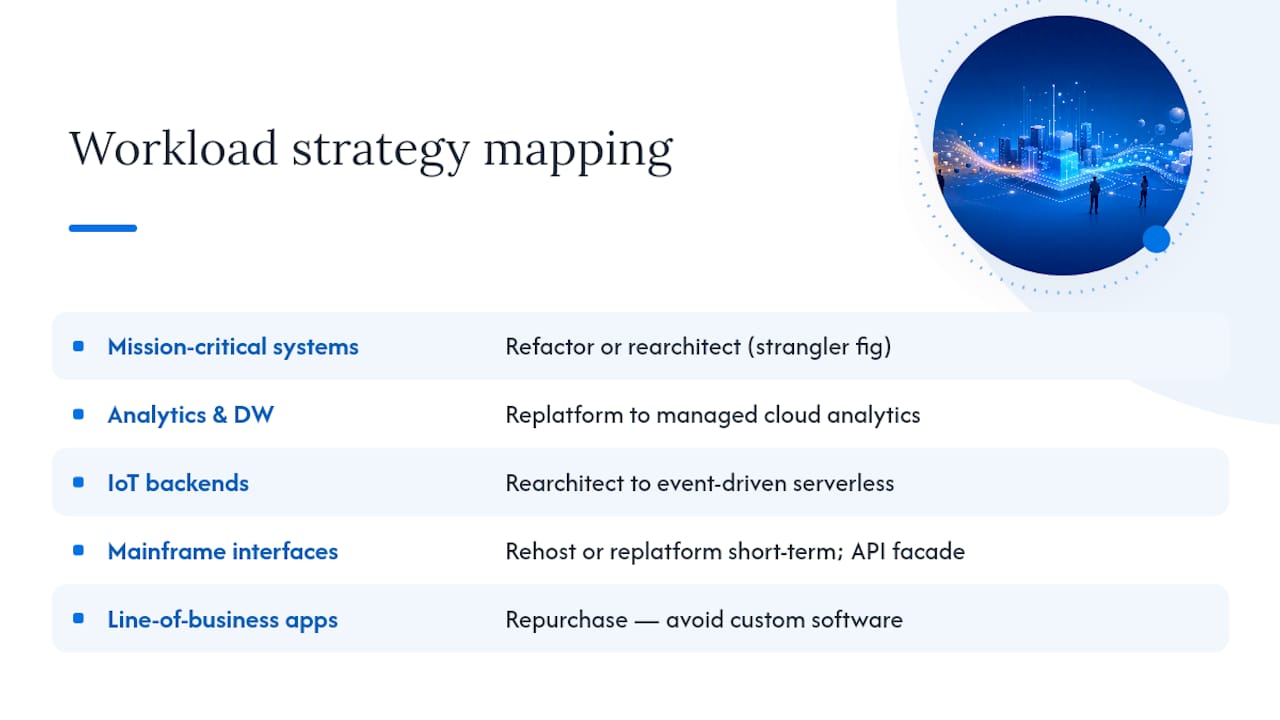
Mission-critical transactional systems, like order management or payment processing, usually call for refactor or rearchitect using the strangler fig pattern, since downtime tolerance is near zero and the business impact of getting the architecture wrong is severe.
Analytics and data warehouse workloads often fit replatform well. Moving from an on-premises data warehouse to a managed cloud analytics platform delivers real performance and cost gains without touching the reporting logic teams already depend on.
IoT backends frequently benefit from rearchitecting toward event-driven, serverless patterns, since the workload itself is naturally spiky and doesn’t map well to always-on infrastructure.
Mainframe interfaces are a classic rehost or replatform candidate in the short term, wrapped behind an API facade, with a longer-term refactor planned once the business has breathing room and clearer requirements.
Line-of-business applications with low differentiation, like expense reporting or internal ticketing, are strong repurchase candidates. Building custom software for a solved problem rarely makes sense.
On platform mapping: AWS shows up most often in prescriptive, phase-driven modernization playbooks with strong support for containerized and serverless rearchitecture. Microsoft Azure is frequently the default for enterprises already invested in the Microsoft ecosystem, particularly for replatforming .NET-based line-of-business applications and hybrid cloud scenarios. IBM remains a common choice specifically for mainframe modernization, given its long history supporting the interfaces and integration layers those systems depend on. None of these platforms is inherently right for every workload. The fit depends on your existing stack, team skills, and compliance requirements more than any vendor’s marketing.
A brief vignette: a mid-sized financial services firm scoped a legacy claims-processing monolith, chose refactor over rearchitect because test coverage already sat above 70%, and used the strangler fig pattern to migrate one claim type at a time behind an API facade. The pilot phase covered a single low-volume claim type over six weeks, then expanded to the remaining claim types over the following two quarters, cutting deployment lead time from weeks to days.
How Do You Build a Reusable Phase 1 Pilot Plan?
A modernization program earns credibility with leadership through artifacts they can actually approve, not just a narrative. Here’s a checklist structure worth copying directly.
Project checklist:
- Complete application inventory with the nine fields described earlier
- Risk assessment scored against the weighted matrix
- Test plan defining coverage thresholds before any refactor work begins
- Rollback procedure documented and tested in a staging environment
- Stakeholder sign-off captured in writing, not verbally, before Phase 1 starts
Communication plan template:
- Weekly working session between the modernization team and application owner
- Biweekly steering committee update to leadership with go/no-go status
- A named escalation path for blockers, with a maximum 48-hour response commitment
- A single source of truth (a shared dashboard or wiki page) tracking phase status, so nobody’s asking “where are we?” in a hallway
A sample Phase 1 pilot plan that leadership can approve without extensive back-and-forth:
- Scope: one workload, selected for low business risk and high potential value
- Owner: a named application owner plus a core modernization lead
- Timeline: four to eight weeks
- Quality gates: test coverage above an agreed threshold, zero critical defects at cutover, rollback tested and confirmed functional
- Success criteria: measurable improvement in deployment frequency or reduced incident rate within thirty days of cutover
Pro Tip: Document your Phase 1 results as a one-page case study before you move to Phase 2, even internally. Teams that skip this step end up re-litigating the same “does this approach even work” argument with every new stakeholder who joins the program.
What Do We See Go Right and Wrong in Real Modernization Projects?
The recurring mistake isn’t technical. It’s scope discipline. Programs that try to modernize an entire portfolio in one initiative almost always stall, because the first visible win takes too long to arrive and executive patience runs out before Phase 2 even starts. The programs that work pick one boring, unglamorous workload, prove the pattern cleanly, and let that success fund the next phase’s political capital.
- Governance gaps kill momentum faster than technical debt does. A program without a clear go/no-go gate between phases drifts into scope creep almost by default.
- Early wins matter more than comprehensive coverage. A single successful pilot, measured and documented, does more to secure Phase 2 budget than a perfect architecture diagram ever will.
- Underinvesting in the communication plan is a quiet failure mode. Engineering teams that modernize in isolation from business stakeholders routinely discover, too late, that a “deprecated” workflow was still load-bearing for someone’s quarterly report.
One anonymized pattern worth sharing: a healthcare technology client came in with a legacy scheduling system that touched compliance-sensitive patient data, wrapped in enough undocumented business logic that nobody wanted to touch it. Rather than attempting a full rearchitecture, the engagement started with a narrow strangler-fig pilot around a single low-risk scheduling workflow, validated data integrity through parallel runs, and only expanded once that pilot cleared its defined success criteria. The measurable impact showed up in reduced incident volume during the following quarter, not in a dramatic architectural before-and-after.
Two recommendations we apply consistently when brought in as a modernization partner: insist on a written inventory and scoring exercise before any code gets touched, even when the client wants to skip straight to building, and never let “modernize” become shorthand for “rewrite everything.” Most estates have a handful of systems that genuinely need rearchitecting and a much longer list that just need to be retired, replatformed, or left alone for another year.
How Seattlesoftwaredevelopers Supports Your Modernization Program
Seattlesoftwaredevelopers gives enterprise IT teams something most modernization vendors don’t: a partner who scopes the assessment and the pilot together, so you’re not paying for a strategy deck that sits disconnected from the engineering team that actually builds the thing.
The engagement typically starts with a scoping call where you bring your application inventory, or a rough list if a full inventory doesn’t exist yet, along with your top compliance and business-continuity constraints. From there, Seattlesoftwaredevelopers helps score candidate workloads, define a Phase 1 pilot, and either execute the refactor or rearchitecture directly or augment your existing team with engineers who’ve handled legacy integration work across healthcare, finance, and education. Governance and security stay built into the process rather than bolted on afterward, which matters most when the legacy system in question touches regulated data. If you’re ready to move past the planning stage, Seattlesoftwaredevelopers’s development process walks through exactly what to prepare for an initial scoping call, and requesting an assessment is the fastest way to find out which of your workloads is your real Phase 1 candidate.
Where to Read More on Legacy Modernization Strategies
- The 6 Rs of application modernization – Microsoft: a practical rundown of when rehost and replatform beat a rebuild.
- AWS Prescriptive Guidance on phased modernization: the source for the MVP-then-scale, split-and-seed sequencing model referenced throughout this guide.
- Legacy Code Modernization: A Practical Guide for Engineering Teams | Sourcegraph: a solid deep dive on the 7 Rs framework and why characterization tests matter before refactoring.
- Legacy System Upgrade: Modernize Without Disruption: useful for the strangler fig pattern and the retirement-candidate inventory statistic.
- How to Scope a Custom Software Project | Seattlesoftwaredevelopers: a practical guide to defining success criteria before committing budget to a modernization phase.
Frequently Asked Questions
What is the most common legacy modernization strategy for enterprises?
There isn’t a single dominant approach. Most enterprise programs combine several of the six canonical strategies, retire, rehost, replatform, refactor, rearchitect, and repurchase, applying each to the workload it fits rather than standardizing on one method across the estate.
How long does a legacy modernization pilot typically take?
A well-scoped Phase 1 pilot generally runs four to eight weeks for a single workload, though broader MVP-style pilots described in AWS’s prescriptive guidance can extend to 12 to 16 weeks depending on scope and dependencies.
Should we rehost or refactor a legacy application?
Rehost when the priority is speed, such as an urgent data center exit, and the application’s architecture doesn’t need to change. Refactor when the application has strong test coverage and the goal is improving maintainability, performance, or security without a full rebuild.
What percentage of legacy applications should be retired instead of modernized?
Portfolio audits commonly find that 15% to 30% of applications in a given enterprise inventory are retirement candidates due to duplication or lack of active use, so retiring those first before investing in modernization elsewhere is usually the highest-leverage early move.
How do we measure ROI on a legacy modernization initiative?
Track deployment frequency, mean time to recovery, infrastructure cost reduction, and the percentage of traffic successfully routed to the modernized service. Infrastructure and maintenance cost reductions in the 20% to 40% annual range are a realistic benchmark once modernization is fully rolled out.
This article provides general information on legacy modernization strategies and is not a substitute for a tailored technical or compliance assessment of your specific environment.
Sources
- AWS Prescriptive Guidance – Phased approach to modernizing applications in the AWS Cloud
- Legacy Code Modernization: A Practical Guide for Engineering Teams | Sourcegraph
Recommended
- Future Trends in Enterprise Software | Seattle Software Developers
- Adopting Enterprise Mobility: Empowering Employees with Mobile Software Solutions | Seattle Software Developers
- Enterprise Software: Enhancing Collaboration and Communication | Seattle Software Developers
- How Custom Software Can Streamline Your Business | Seattle Software Developers