


Adopt a written student data privacy program now: inventory what data you hold, assign a data steward, document every disclosure, and require signed data-protection agreements from every vendor touching student records. That is the single action that closes most of the gap between what schools collect and what they actually protect.
The district or school system carries legal responsibility under FERPA. Day-to-day ownership should sit with a data steward, often the CIO or Director of Technology, who can enforce policy across departments.
Same-day priorities:
- Notify your superintendent, principal, and IT lead that a formal privacy review is starting.
- Start a basic inventory of what student data systems exist and who has access.
- Pause any new data-sharing arrangement that lacks a signed agreement.
- Confirm your annual FERPA notice went out to families this school year.
- Identify who currently owns vendor contract review, even informally.
Pro Tip: Assign one person the title of data steward, even part time. Programs without a named owner drift for years, while programs with one usually produce a full inventory within a single term.
Key Takeaways
Student data privacy compliance depends on a named data steward, a documented data inventory, enforceable vendor contracts, and logged disclosures maintained year round.
| Point | Details |
|---|---|
| Name an owner | Assign a data steward or CIO to run the program instead of leaving it to informal ownership. |
| Inventory before policy | Map every system, vendor, and data type before writing or updating privacy policies. |
| Contracts need teeth | Require audit rights, no-data-mining clauses, and defined deletion timelines from every vendor. |
| Log every disclosure | FERPA requires disclosure recordkeeping and a 45-day response window for access requests. |
| Build secure-by-design | Seattlesoftwaredevelopers builds auditable, governance-first systems for districts replacing legacy tools or unmanaged vendor integrations. |
Table of Contents
- What Federal and State Student Data Privacy Laws Require
- Who Holds Rights and Who Must Act on Them
- Building a Student Data Privacy Program Step by Step
- Vetting Edtech Vendors and Locking Down Contract Language
- Technical and Administrative Controls That Actually Reduce Risk
- Common Student Privacy Violations Schools Should Watch For
- Responding to a Student Data Breach or FERPA Complaint
- The Privacy-Security Gap Nobody Talks About
- Where to Find Model Notices and Training Materials
- What Schools Consistently Get Wrong
- When to Bring In a Software Development Partner
- Frequently Asked Questions
- Sources
What Federal and State Student Data Privacy Laws Require
Three federal laws and a growing patchwork of state statutes govern how schools handle student records, and they do not always overlap the way people assume. FERPA is the foundation. It defines an education record broadly, covers everything from transcripts to disciplinary files to certain email communications, and gives parents and eligible students the right to inspect records, request amendments, and receive an annual notice of their rights. Schools must respond to inspection requests within a reasonable period, no more than 45 days, and keep a record of most disclosures.45-day rule
PPRA restricts surveys that touch sensitive topics like political beliefs or family income, requiring parental notice and opt-out rights. COPPA governs any tool collecting personal information from children under 13; schools can consent on parents’ behalf for educational use, but never for a vendor’s commercial data mining.
State law adds another layer entirely. Lawmakers have passed numerous student-data privacy statutes since 2014, many banning commercial use of student data or granting parents rights FERPA does not mention.state laws
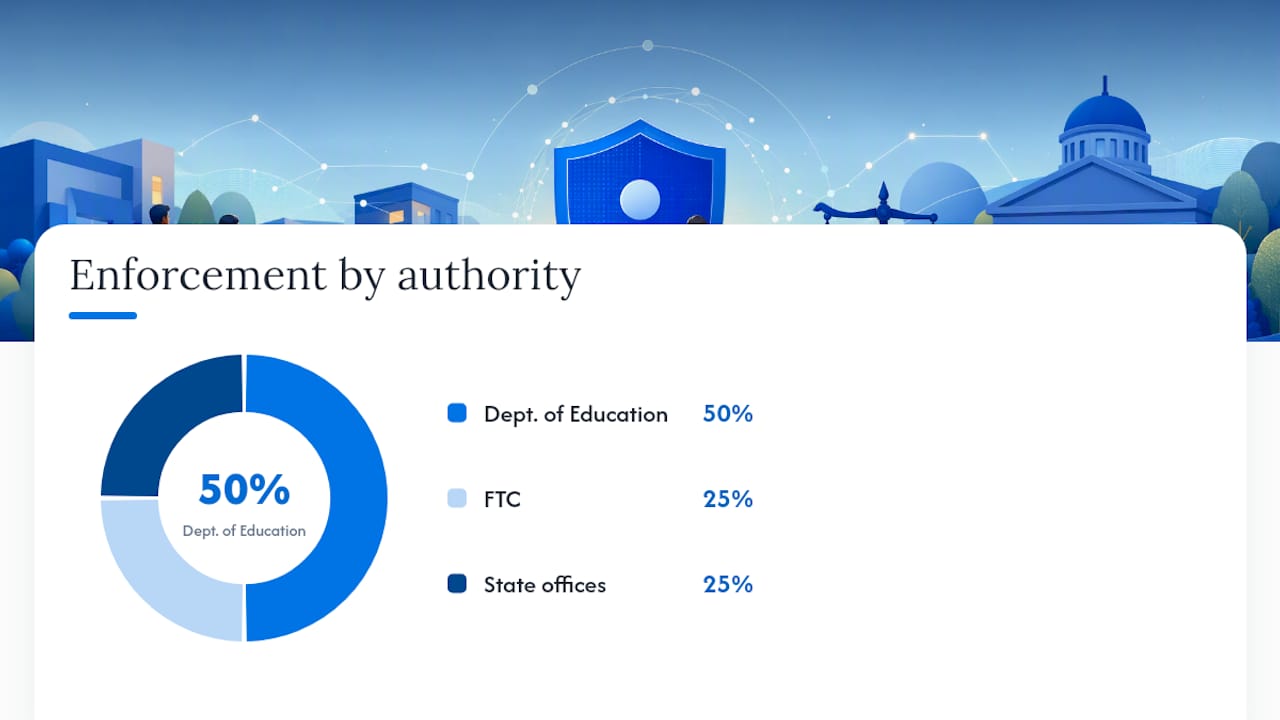
| Law | What it governs | Who enforces it |
|---|---|---|
| FERPA | Access, amendment, and disclosure of education records | U.S. Department of Education (SPPO) |
| PPRA | Surveys covering sensitive personal topics | U.S. Department of Education |
| COPPA | Online collection of data from children under 13 | Federal Trade Commission |
| State statutes | Vendor limits, commercial-use bans, extra parental rights | State attorney general or education office |
Pro Tip: When a vendor contract touches’ health, disability, or biometric data, loop in counsel or your state education office before signing. State law often sets a stricter bar than federal law here.
Who Holds Rights and Who Must Act on Them
Rights and duties in student data privacy compliance sit with different people depending on the student’s age and the record type.
- Parents hold FERPA rights until a student turns 18 or enrolls in a postsecondary institution, at which point rights transfer to the eligible student.
- Schools must issue an annual notice of rights, respond to access requests within 45 days, and offer an amendment process for inaccurate records.
- Vendors typically act as “school officials” under FERPA’s exception only when a written agreement limits their use of data to the contracted educational purpose.
- Anyone reviewing SPPO’s guidance will find worked examples of these exact scenarios, including how directory information exceptions apply.
A vendor handling grades, attendance, or behavioral data isn’t automatically covered by FERPA’s school-official exception. That exception only applies when a signed agreement restricts the vendor’s use, retention, and redisclosure of the data to the specific educational purpose you hired them for.
Does a parent lose all rights once a child turns 18? Yes, for FERPA purposes rights transfer fully to the eligible student, though many schools still notify parents as a courtesy on non-sensitive matters.
Building a Student Data Privacy Program Step by Step
A working program rests on seven pillars: governance, a data inventory, written policies, access controls, staff training, an incident response plan, and audit trails that survive a records request.
- Weeks 1 to 2: Name a data steward and stand up a short governance committee (IT, a curriculum lead, and a compliance-minded administrator).
- Weeks 3 to 6: Complete a data inventory: every system, every data type, every vendor with access.
- Weeks 7 to 8: Draft or update the annual notice and a basic vendor-agreement template.
- Weeks 9 to 10: Roll out role-based access controls tied to actual job functions.
- Weeks 11 to 12: Train staff and run a tabletop exercise simulating a breach.
- Ongoing: Review vendor contracts annually and re-run the inventory each fall.
Not all data carries equal risk. Special education records, health information, and disciplinary files need tighter access controls and shorter retention windows than routine attendance data.
- High-sensitivity: IEPs, health records, counseling notes, biometric data.
- Moderate-sensitivity: grades, discipline records, behavioral analytics.
- Lower-sensitivity: directory information, unless a parent has opted out.
Pro Tip: Build your risk tiers into role descriptions, not just policy documents. “Access to IEP data” should appear as a line item in the job posting for anyone who touches special education systems.
Vetting Edtech Vendors and Locking Down Contract Language
Most privacy failures trace back to a vendor relationship nobody vetted properly. Before signing anything, ask for the vendor’s security posture, a list of subprocessors who touch the data, their deletion policy, and their breach notification timeline in writing.
Contracts need specific clauses, not vague reassurances:
- Permitted-use language limiting data to the exact educational purpose contracted.
- A no-commercial-use and no-data-mining clause with no carve-outs.
- Audit rights letting the district verify compliance on request.
- A defined data-return-or-deletion process at contract end.
- Encryption requirements for data at rest and in transit, plus a stated data location.
- Liability and indemnity terms that hold the vendor accountable for its own breach.
| Contract element | Why it matters | Red flag if missing |
|---|---|---|
| Data deletion timeline | Confirms data doesn’t persist past the contract term | Vague “as needed” retention language |
| Breach notification window | Sets how fast you learn about exposure | No stated timeframe at all |
| Subprocessor disclosure | Reveals who else touches student data | Vendor won’t name subprocessors |
| No-data-mining clause | Blocks commercial reuse of student records | Broad “improve our services” rights |
Practical FERPA compliance checklists consistently flag missing audit rights and vague data-mining language as the two clauses districts most often skip and later regret.
Pro Tip: Put your must-have clauses directly into the RFP, not just the final contract. Vendors who balk at the RFP stage will almost never accept them later.
Technical and Administrative Controls That Actually Reduce Risk
Small districts don’t need enterprise budgets to close most of the privacy-security gap. They need the right controls in the right order.
- Build and maintain a single authoritative student data inventory with classification tags for sensitivity.
- Require multifactor authentication for any account touching student records.
- Encrypt data at rest and in transit as a baseline, not an upgrade.
- Enable logging and monitoring on systems holding education records.
- Apply role-based access control so staff see only what their job requires.
- Patch systems on a defined cadence rather than an ad hoc one.
Pair those technical steps with administrative discipline:
- Enforce least-privilege access reviews at least twice a year.
- Run annual staff training tied to real scenarios, not generic slideshows.
- Set retention and disposal schedules so old data doesn’t linger unmonitored.
- Reassess vendor access whenever staff or contract terms change.
Pro Tip: Your disclosure log isn’t paperwork. FERPA requires it, and a clean log is often the fastest way to close out a parent complaint or a district audit without escalation.
Common Student Privacy Violations Schools Should Watch For
Most violations are mundane, not dramatic: a teacher posts a class photo without checking opt-out lists, a front office shares a student’s schedule with the wrong caller, or a vendor gets access far broader than the contract allows.
- Publishing photos or videos that include students whose families opted out of directory information disclosure.
- Sharing grades or discipline records with a third party absent consent or a valid FERPA exception.
- Letting a vendor’s data access outlive the contract or exceed its stated purpose.
SPPO’s guidance on photos and directory information clarifies that directory information rules only protect a school when the family never opted out and the intended use matches the notice given.
A single unchecked opt-out list can turn a routine yearbook photo into a FERPA complaint. The fix costs nothing: cross-reference the opt-out list before any public posting, every time.
Responding to a Student Data Breach or FERPA Complaint
Speed and documentation matter more than perfection in the first 24 hours after a breach.
- Contain the exposure immediately, revoking access or taking the affected system offline.
- Notify your data steward, superintendent, and legal counsel the same day.
- Document the timeline, scope, and affected records in writing.
- Notify affected families promptly, and notify state authorities if your state law requires it.
- File any required notice with the U.S. Department of Education if the breach involves federally funded programs.
FERPA itself sets a firm outer limit worth remembering: schools must respond to a records access request within 45 days, and disclosure logs must be kept current enough to answer a complaint on short notice.
- Keep every breach-related email and decision in one incident file.
- Use SPPO’s breach-response checklist as your containment and notification template.
- Direct formal FERPA complaints to the Department of Education’s Student Privacy Policy Office, which investigates and issues findings on alleged violations.
The Privacy-Security Gap Nobody Talks About
Policy experts describe a privacy-security gap: schools collect more student data every year for instruction and analytics, but security investment hasn’t kept pace.
The fastest fixes are unglamorous: inventory what you hold, cap vendor access, log every disclosure, train staff annually, and encrypt what you can. None of it requires a large budget.
Where to Find Model Notices and Training Materials
You don’t need to draft privacy documents from scratch. SPPO publishes model notices and parent guides covering FERPA basics in plain language, alongside training modules districts can assign directly to staff.
- Download SPPO’s annual notice template and adapt it with your district’s contact information.
- Use the breach-response checklist as your incident-response starting point.
- Assign SPPO’s training modules to new staff during onboarding, not just once a year.
How long does it take to roll out a full privacy program? Most districts can adopt one template, train staff, and issue an updated annual notice within a single school term if a data steward owns the rollout.
What Schools Consistently Get Wrong
Districts spend most of their energy on the annual notice and almost none on vendor oversight, even though vendor relationships create the largest ongoing exposure. Seattlesoftwaredevelopers has seen this pattern across regulated industries: the paperwork gets attention, but the systems processing the data get built without governance baked in from day one. Secure-by-design systems, not after-the-fact patches, are what actually hold up under audit.

For a district starting from zero, the 90-day priority list is short: build the data inventory first, fix vendor contract language second, and turn on access logging third. Everything else can wait a term.
When to Bring In a Software Development Partner
Some privacy gaps can’t be closed with policy alone. Legacy student information systems, complex integrations between a district’s SIS and a dozen edtech tools, or a required audit trail that your current vendor can’t produce all point to the same conclusion: you need custom-built infrastructure, not another point solution.

When you reach that stage, ask a development partner to build specific, verifiable deliverables: a data inventory and classification tool, role-based access control tied to real job functions, encryption at rest and in transit, audit logging that survives a records request, a vendor-data dashboard showing exactly who has access to what, and a documented breach-response workflow. During discovery or an RFP, ask candidates to walk through how they build security into custom software from the first sprint, not bolted on before launch. Seattlesoftwaredevelopers builds exactly this kind of governance-first system for healthcare, finance, and education clients who need auditability under real production load. If a legacy system or a tangle of vendor integrations is the actual blocker to your student data privacy compliance, review the step-by-step custom development process and start a discovery conversation before your next contract renewal.
Frequently Asked Questions
Does FERPA apply to private schools? FERPA applies only to schools receiving federal funding through the Department of Education; many private schools fall outside its scope but may follow state law or contractual obligations instead.
Can a teacher post student work on a classroom website without consent? Only if the material doesn’t reveal personally identifiable information, or if directory information rules apply and no opt-out is on file.
What’s the difference between FERPA and COPPA for a classroom app? FERPA governs the school’s education records generally, while COPPA specifically governs data collection from children under 13 by online services, with schools able to consent on parents’ behalf only for educational use.
Who investigates a FERPA complaint? The Department of Education’s Student Privacy Policy Office reviews complaints and can require corrective action from a noncompliant school or district.
How often should staff receive student data privacy training? Annually at minimum, with additional training whenever new systems or vendor tools are introduced.
This article is general information, not a substitute for advice from a qualified lawyer. Consult a qualified legal professional about your own circumstances before acting on anything here.
Sources
Start with SPPO’s program guidance and model notices, review the FERPA statutory text directly, and consult the FPF Policymakers’ Guide for state-law context. Adopt the annual notice template first, then the vendor-agreement checklist.
Recommended
- The Rise of Personalized Medicine: Customizing Medical Apps | Seattle Software Developers
- User-Centered Design: Developing Intuitive Medical Apps | Seattle Software Developers
- Enterprise Software: Enhancing Collaboration and Communication | Seattle Software Developers
- How Custom Software Can Streamline Your Business | Seattle Software Developers