


AI data privacy is the practice of preventing the data used to train or run AI systems from exposing information about the people behind it, whether that exposure happens during training, at inference, or somewhere in between. It differs from ordinary data privacy because the risk doesn’t stop once you secure a database. A model can memorize a patient record, a customer’s financial history, or a private conversation and reproduce it later, sometimes to someone who never had permission to see it in the first place.
The current risk posture is worse than most teams assume. Foundation models trained on scraped internet data and prompt-based services that retrieve live context have both widened the attack surface well beyond what traditional software ever created, according to Stanford HAI’s policy analysis. If you’re building or buying AI systems right now, the single most important move is this: minimize what data reaches the model in the first place, then wrap what remains in governance and privacy-preserving controls.
Three pillars carry most of the weight:
- Data minimization — strip, mask, or exclude personal data before it ever touches a training set or a prompt.
- AI data governance — discovery, classification, access control, and audit logging that treat AI systems as first-class data processors.
- Privacy-preserving techniques — differential privacy, federated learning, encryption, or a hybrid of these, matched to the sensitivity of the data involved.
Key Takeaways
AI data privacy succeeds when data minimization, governance automation, and the right privacy-preserving technique are matched deliberately to the sensitivity of the data involved.
| Point | Details |
|---|---|
| Minimize before you build | Strip personal data from training sets and prompts before they reach any model, not after a leak. |
| Match technique to threat model | Use differential privacy for statistical guarantees, federated learning when data can’t leave its source, and HE/SMPC only for high-sensitivity cases. |
| Automate governance, don’t audit periodically | Continuous discovery and classification prevent the common failure of models training on data that later becomes restricted. |
| Test for leakage proactively | Run membership-inference checks and adversarial prompt tests before attackers find the gaps for you. |
| Partner with governance-first developers | Seattlesoftwaredevelopers builds discovery, redaction, and audit logging into custom AI projects from the architecture stage, not after launch. |
Table of Contents
- Why AI Changes the Privacy Equation
- How Privacy Attacks Against AI Actually Work
- Privacy-Preserving Techniques: DP, Federated Learning, HE, SMPC, and Hybrids
- AI Data Governance: An Operational Framework
- Regulatory and Policy Landscape That Affects AI Data Privacy
- Practical Steps: An Action Checklist for Organizations and Professionals
- Engineering Patterns and Tooling to Build Privacy-Preserving AI Systems
- How Seattle Software Developers Operationalizes AI Data Governance in Custom Projects
- Case Studies and Lessons From Real AI Data Privacy Breaches
- Treating Privacy as Engineering, Not a Policy Memo
- Building Secure AI Systems With Governance Built In
- Sources
Why AI Changes the Privacy Equation
Traditional software leaks data through bugs: a misconfigured database, an exposed API key, a SQL injection. AI systems leak data through something closer to the model’s actual function. When a large language model trains on billions of scraped documents, there’s no reliable way to guarantee none of that text contains names, medical details, or account numbers, and once that information is baked into the model’s parameters, deleting it isn’t as simple as running a DELETE query.
Three separate points in the AI lifecycle each introduce their own exposure:
- Training time: models absorb whatever was in the training corpus, including personal data that was scraped without consent.
- Inference time: prompts, retrieved documents, and conversation history all pass through systems you may not fully control, especially with third-party APIs.
- Output time: models sometimes reproduce memorized fragments of training data verbatim, a phenomenon researchers call memorization or regurgitation.
Foundation models make this worse because of scale. A model trained on a narrow, curated dataset has a smaller surface for memorization. A model trained on a broad scrape of the public internet, plus whatever fine-tuning data a company layers on top, has both more opportunities to memorize sensitive text and less transparency about what it actually learned. Institutional researchers have flagged this as a lifecycle problem rather than a single point of failure, warning that risk accumulates from initial scraping all the way through to memorized outputs and adversarial extraction, according to Stanford HAI.
Governance gaps aren’t a side issue. They’re the leading blocker. Industry research from KPMG found that 62% of organizations cite a lack of data governance as a main inhibitor to their AI initiatives, ahead of budget or talent constraints. That number should reframe how you think about AI data privacy: it’s not primarily a legal checkbox problem, it’s an operational readiness problem.
Consider healthcare and finance, two industries where the stakes compound fast. A clinical AI tool trained on de-identified patient notes can still leak identity if the de-identification was incomplete, a risk that becomes existential once you’re dealing with rare diagnoses or small patient populations where “anonymized” data is easier to re-identify than it looks. A finance chatbot connected to a customer’s account history through a retrieval system can leak transaction details to the wrong session if context isn’t properly scoped per user. These aren’t hypothetical edge cases. They’re the predictable result of connecting powerful models to sensitive data without governance in place, a pattern explored in more depth in our look at AI ethics in healthcare.
How Privacy Attacks Against AI Actually Work
Understanding the mechanics of these attacks matters because each one demands a different defense. You can’t redact your way out of a model inversion attack, and you can’t differential-privacy your way out of a prompt injection. Here’s what security teams are actually seeing:
-
Membership inference attacks let an attacker determine whether a specific record was part of a model’s training data, often just by observing how confidently the model responds to queries about that record. This matters most when training data membership itself is sensitive, such as inclusion in a medical study or a list of loan applicants who were denied.
-
Model inversion and extraction attacks go a step further, attempting to reconstruct actual training examples or steal the model’s learned parameters outright. A sufficiently determined attacker with API access can sometimes coax a model into regurgitating memorized text, including names, addresses, or proprietary content it was never supposed to reveal.
-
Prompt injection and prompt leakage exploit the conversational interface itself. An attacker embeds hidden instructions in a document, email, or web page that the AI later processes, tricking the system into revealing its system prompt, prior conversation context, or connected data sources.
-
Data poisoning attacks the pipeline before the model ever ships, injecting manipulated examples into training or fine-tuning data so the model behaves badly, or leaks selectively, once deployed.
Foundation models create privacy risk across the entire lifecycle, not at a single point. The exposure starts with mass scraping of public data and continues through memorized outputs that adversarial queries can pull back out, which is why point fixes rarely solve the underlying problem.
That framing, drawn from Stanford HAI’s research, is the reason single-control defenses tend to fail. A team that redacts prompts but ignores training data provenance has closed one door and left three open. Membership inference in particular requires relatively modest attacker capability, often just repeated querying and statistical analysis, which is exactly why it shows up so often in academic red-teaming exercises against production-style models.
Privacy-Preserving Techniques: DP, Federated Learning, HE, SMPC, and Hybrids
No single privacy-preserving technique solves every problem, and picking the wrong one for your use case usually means paying a real cost in accuracy or speed for a guarantee you didn’t need. Here’s how the main approaches actually compare.
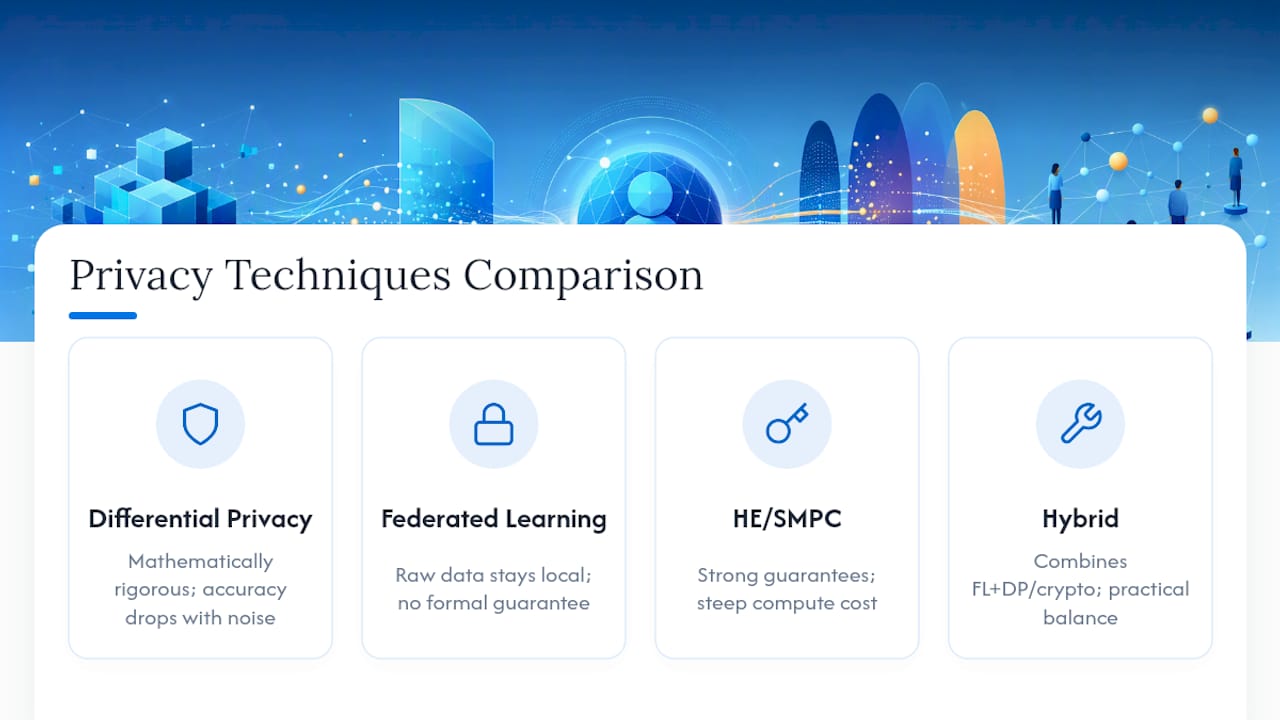
Differential privacy (DP) adds calibrated statistical noise to data or model outputs so no single individual’s record can be reliably inferred, even by an attacker with significant background knowledge. It’s mathematically rigorous and already used in production by major technology companies, but the guarantee comes with a real trade-off: more noise means stronger privacy and worse model accuracy, and tuning that balance is where most DP implementations succeed or fail, according to peer-reviewed analysis of privacy-preserving AI in biomedicine.
Federated learning keeps raw data on local devices or servers and only shares model updates, not the underlying records, with a central aggregator. This is attractive for hospitals or banks that legally can’t pool raw records, but it introduces communication overhead and doesn’t provide a formal privacy guarantee on its own. Without combining it with DP or cryptographic protection, federated learning can still leak information through the model updates themselves.
Homomorphic encryption (HE) and secure multiparty computation (SMPC) let computations run directly on encrypted data, so the underlying values never need to be decrypted during processing. These offer some of the strongest guarantees available, but that strength comes at a steep computational cost, often making them impractical for large-scale, latency-sensitive applications without careful engineering, per the same PMC review.
Hybrid approaches that combine federated learning with DP or lightweight cryptography are emerging as the most practical path for sensitive domains like biomedicine, balancing meaningful privacy guarantees against real-world compute budgets.
Recent research is shifting what’s actually feasible. MIT researchers developed FTTE, a method that speeds up privacy-preserving federated training by roughly 81%, cuts on-device memory overhead by about 80%, and reduces communication payload by close to 69%. That’s not an incremental tweak. It changes the calculus for running federated learning on ordinary phones and edge devices instead of requiring specialized hardware, which had been one of the biggest practical barriers to deploying privacy-preserving AI outside of well-funded research labs.
Pro Tip: Don’t default to the strongest cryptographic technique just because it sounds safest. Match the technique to the actual threat model: use DP when you need statistical guarantees against re-identification, federated learning when data legally can’t leave its source, and reserve HE/SMPC for the narrow set of cases where computation on fully encrypted data is worth the latency and cost.

Picking the right technique comes down to three questions: How sensitive is the data? Can it leave its current environment at all? And how much accuracy or latency can you afford to trade for the privacy guarantee you need? A consumer recommendation engine can tolerate DP’s noise. A diagnostic model built on rare-disease patient records probably needs a hybrid approach, because the population is small enough that even modest re-identification risk becomes serious.
AI Data Governance: An Operational Framework
Privacy-preserving math means nothing if the data governing your AI system is undocumented, unclassified, and untracked. Governance is the operational layer that makes every technique above actually enforceable, and it breaks down into five pillars.
-
Discovery and classification. You can’t protect data you don’t know you have. Automated discovery tools that tag sensitive fields at the point of creation, rather than relying on periodic manual audits, prevent the common failure where a model ends up training on data that later gets reclassified as restricted.
-
Access and identity controls. Every system, human or AI agent, that touches training data or live prompts needs scoped, auditable access, not a shared service account with blanket permissions.
-
In-flight protections. Redaction and data loss prevention (DLP) tooling that scans prompts and retrieved context before it reaches a model catches sensitive data leaks before they happen, rather than after.
-
Audit and accountability. Unified audit logs that tie AI interactions back to tickets, user identities, and specific model versions give you the evidence trail regulators and auditors expect, an approach detailed in KPMG’s governance framework.
-
Vendor and model lifecycle management. Every third-party model or API you integrate needs the same scrutiny as an internal system, including documentation of what it was trained on and what happens to your data once it’s sent.
The biggest operational risk isn’t a missing control, it’s a stale one. Policies written six months before your last model update rarely reflect what that model can now do. Industry guidance increasingly recommends unifying data governance and AI governance into a single program with automated, continuous monitoring instead of point-in-time reviews, per KPMG’s 2025 analysis.
Pro Tip: Auditors don’t want a policy document. They want artifacts: access logs, DPIA records, retention schedules, and evidence that your controls actually fired when tested. Build the paper trail into your pipeline from day one instead of reconstructing it after an incident.
Map these five pillars to existing frameworks rather than inventing your own taxonomy. The NIST AI Risk Management Framework, ISO 42001, and SOC 2 all cover overlapping ground, and aligning your governance program to at least one of them makes vendor conversations and audits considerably faster.
Regulatory and Policy Landscape That Affects AI Data Privacy
Compliance obligations for AI data processing come from several directions at once, and none of them fully cover the gaps the others leave open.
- GDPR requires data minimization, purpose limitation, and Data Protection Impact Assessments (DPIAs) for high-risk processing, obligations that apply directly to AI training and inference when personal data from EU residents is involved. The EU AI Act adds its own data governance article specifically targeting high-risk AI systems.
- U.S. federal guidance remains largely principle-based rather than binding. The OSTP’s AI Bill of Rights sets expectations around transparency, privacy protections, and risk assessment that organizations should map to internal controls even without a direct enforcement mechanism.
- Sector-specific rules still carry real teeth. HIPAA governs health data used in AI systems regardless of whether the AI vendor is a covered entity, which is why Business Associate Agreements matter as much as the model architecture itself.
- State privacy laws, including California’s CPRA, Colorado’s privacy act, and Texas’s data privacy statute, are increasingly writing AI-specific provisions into what were originally general consumer privacy laws.
- Contractual obligations with AI vendors deserve as much scrutiny as the regulations themselves: BAAs for healthcare data, explicit restrictions on using customer data for model training, and contractual rights to audit evidence.
The regulatory gap that catches most teams off guard is enforcement timing. State AI-specific provisions are still developing, which means the safest posture is building to the strictest applicable standard now rather than waiting for a final rule that clarifies the floor.
Practical Steps: An Action Checklist for Organizations and Professionals
Turning all of this into daily practice comes down to five categories of work, roughly in the order you should tackle them.
-
Minimize data at both the dataset and prompt level. Before any training run or API call, ask whether the personal data included actually needs to be there. Most of the time, it doesn’t.
-
Redact and pseudonymize before data leaves your control. Automated prompt-level redaction and pseudonymization catch sensitive fields, names, account numbers, medical identifiers, before they ever reach a third-party model, and they generate the audit evidence governance programs need.
-
Vet vendors on evidence, not marketing claims. Require SOC 2 or ISO 42001 certification, signed BAAs where health data is involved, and explicit contractual language restricting your data from being used in future model training. A tool overview like our roundup of AI software worth evaluating is a useful starting point for comparing what different vendors actually disclose.
-
Test for leakage before attackers do. Run membership-inference checks against your own models, throw adversarial prompts at chat interfaces to probe for prompt injection vulnerabilities, and scan outputs for memorized sensitive content on a recurring schedule, not just at launch.
-
Operationalize retention and incident response specifically for model leaks. Define how long training data and prompt logs are retained, review access permissions on a fixed cadence, and write an incident response plan that accounts for the reality that you can’t simply “delete” a memorized fact from a deployed model the way you’d delete a database row.
Pro Tip: Treat prompt logs the same way you’d treat any other sensitive data store. If your customer support team can paste a customer’s full account history into a chatbot prompt with no logging or redaction, that’s a governance gap regardless of what your data policy says on paper.
Data clean rooms are worth understanding here too. They offer a structured way for two parties to collaborate on data analysis without either side directly exposing raw records to the other, an architecture originally built for privacy-first marketing collaboration that’s increasingly relevant to AI training partnerships, as explained in this breakdown of data clean room architecture.
Engineering Patterns and Tooling to Build Privacy-Preserving AI Systems
Governance policy only works if engineering teams can actually implement it without grinding development to a halt. That means building privacy controls into the pipeline itself, not bolting them on after a model ships.
- Prompt-level DLP and inline redaction scan text before it reaches a model API, stripping or masking personal identifiers in real time rather than relying on developers to remember to do it manually.
- Pseudonymization and tokenization, along with format-preserving fake data for testing environments, let engineers work with realistic-looking data without exposing real records during development and QA.
- Inference-time filters and output sanitization catch memorized sensitive content before it reaches an end user, functioning as a second line of defense behind training-time controls.
- Model provenance and versioning metadata track what data trained each model version, which is exactly the artifact auditors ask for when a privacy question comes up months after deployment.
Automating discovery and classification at the point of data creation, rather than relying on periodic manual audits, is one of the most effective ways to prevent sensitive data from reaching a model pipeline in the first place, and it produces the audit trail governance teams need without adding manual review overhead to every project.
Every engineering choice here involves a trade-off between latency, cost, and where processing happens. Edge-based privacy-preserving training reduces the amount of raw data that ever travels to a central server, but historically it demanded more compute and memory than most consumer devices could handle. That’s precisely the constraint MIT’s FTTE method targets, cutting memory overhead by roughly 80% and communication payload by close to 69%, which makes edge deployment of federated learning realistic for teams that previously ruled it out on hardware grounds. For deeper background on how AI integration decisions ripple through a development lifecycle, our guide to AI integration best practices covers the broader engineering context.
How Seattle Software Developers Operationalizes AI Data Governance in Custom Projects
Security and governance sit at the center of how Seattlesoftwaredevelopers approaches custom AI builds, not as a compliance afterthought layered in near launch. That means discovery, redaction, and audit logging get designed into the development lifecycle from the first architecture conversation, so the evidence auditors eventually ask for already exists by the time a system reaches production.
For healthcare and finance clients specifically, that translates into privacy-by-design decisions from day one: BAAs signed before any patient data touches a pipeline, and access controls scoped tightly enough that a breach in one module doesn’t cascade across an entire platform.
If you’re scoping a vendor conversation for your own AI project, bring these items to the first meeting:
- A data classification summary of what’s flowing into the system
- Evidence expectations: SOC 2, ISO 42001, or equivalent
- Retention and deletion requirements for training and prompt data
- Who owns incident response if a model leaks sensitive output
Case Studies and Lessons From Real AI Data Privacy Breaches
The pattern behind most publicized AI privacy incidents is depressingly consistent: a system designed for one purpose gets connected to data it was never properly scoped to handle, and nobody notices until an outside researcher or a curious user finds the gap.
Chatbot memorization incidents follow a familiar script. Researchers probing production language models have repeatedly demonstrated that carefully crafted queries can coax out memorized fragments of training text, including personal details that should never have surfaced. The lesson isn’t that memorization can be eliminated entirely, it’s that output filtering and training data hygiene both need to exist simultaneously, because neither one alone catches everything.
Retrieval-augmented systems have their own failure mode: context bleed, where one user’s session inadvertently surfaces another user’s retrieved documents because session isolation wasn’t enforced strictly enough at the retrieval layer. This is precisely why the European Data Protection Board’s high bar for anonymization matters. A model is only genuinely anonymous if re-identification risk stays negligible even under realistic attack conditions, not just under the conditions the original engineers tested for.
The consistent lesson across these incidents is that privacy failures in AI systems are rarely dramatic hacks. They’re scoping failures, an access control that was slightly too broad, a redaction step that was skipped for one data source, a retrieval system that trusted session boundaries it shouldn’t have.
Treating Privacy as Engineering, Not a Policy Memo
The gap between organizations that handle AI data privacy well and those that don’t rarely comes down to legal sophistication. It comes down to whether privacy decisions get made in the architecture phase or bolted on after something breaks. Every governance framework in this article works only when engineering, legal, and product teams sit in the same room early, because a redaction rule that legal wants but engineering never implements is worth exactly nothing.
If you take one thing from this article into your next vendor conversation, make it the checklist from the governance section. Hand it to whoever you’re evaluating and watch how they respond. The answer tells you more than any sales deck will.
— Andreina
Building Secure AI Systems With Governance Built In
If the governance and engineering patterns in this article sound like a lot to implement alongside your actual product roadmap, that’s because they are, and it’s exactly the kind of work Seattlesoftwaredevelopers builds into custom AI projects from day one rather than treating as a late-stage compliance scramble.

Seattlesoftwaredevelopers develops secure custom AI systems with governance, redaction, and audit logging designed into the architecture from the start, including HIPAA-aware platforms for healthcare clients and financial applications that need to withstand real regulatory scrutiny under production traffic. Our teams have built compliance-focused systems across healthcare, finance, and education, industries where a privacy gap isn’t just a technical bug, it’s a legal exposure. If your organization is planning an AI system that touches sensitive data, read our breakdown of security-first custom development and reach out to scope what governance and privacy controls your specific project actually needs before you write a line of code.
Sources
- Enabling privacy-preserving AI training on everyday devices | MIT News
- Privacy-Preserving Artificial Intelligence Techniques in Biomedicine | PMC
- Data privacy and foundation models: Can we have both? | Stanford HAI
- Rebuilding data governance in the age of AI | KPMG (2025)
- AI Bill of Rights | Office of Science and Technology Policy (White House)
Recommended
- How AI Is Transforming Businesses | Seattle Software Developers
- Investing in AI for Healthcare? Don’t Overlook These Ethical Considerations | Seattle Software Developers
- Top AI Software Tools Every Business Should Invest IN | Seattle Software Developers
- AI is Transforming Software Development | Seattle Software Developers